


Sat, 16 Dec 2023
My Git pre-commit hook contained a footgun
The other day I made some changes to a program, but when I ran the tests they failed in a very bizarre way I couldn't understand. After a bit of investigation I still didn't understand. I decided to try to narrow down the scope of possible problems by reverting the code to the unmodified state, then introducing changes from one file at a time.
My plan was: commit all the new work, reset the working directory back to the last good commit, and then start pulling in file changes. So I typed in rapid succession:
git add -u
git commit -m 'broken'
git branch wat
git reset --hard good
So the complete broken code was on the new branch wat.
Then I wanted to pull in the first file from wat. But when I
examined wat there were no changes.
Wat.
I looked all around the history and couldn't find the changes. The
wat branch was there but it was on the current commit, the one with
none of the changes I wanted. I checked in the reflog for the commit
and didn't see it.
Eventually I looked back in my terminal history and discovered the
problem: I had a Git pre-commit hook which git-commit had
attempted to run before it made the new commit. It checks for strings
I don't usually intend to commit, such as XXX and the like.
This time one of the files had something like that. My pre-commit
hook had printed an error message and exited with a failure status, so
git-commit aborted without making the commit. But I had typed the
commands in quick succession without paying attention to what they
were saying, so I went ahead with the git-reset without even seeing
the error message. This wiped out the working tree changes that I had
wanted to preserve.
Fortunately the git-add had gone through, so the modified files were
in the repository anyway, just hard to find. And even more
fortunately, last time this happened to me, I wrote up
instructions about what to do.
This time around recovery was quicker and easier. I knew I only
needed to recover stuff from the last add command, so instead of
analyzing every loose object in the repository, I did
find .git/objects -mmin 10 --type f
to locate loose objects that had been modified in the last ten minutes. There were only half a dozen or so. I was able to recover the lost changes without too much trouble.
Looking back at that previous article, I see that it said:
it only took about twenty minutes… suppose that it had taken much longer, say forty minutes instead of twenty, to rescue the lost blobs from the repository. Would that extra twenty minutes have been time wasted? No! … The rescue might have cost twenty extra minutes, but if so it was paid back with forty minutes of additional Git expertise…
To that I would like to add, the time spent writing up the blog article was also well-spent, because it meant that seven years later I didn't have to figure everything out again, I just followed my own instructions from last time.
But there's a lesson here I'm still trying to figure out. Suppose I want to prevent this sort of error in the future. The obvious answer is “stop splatting stuff onto the terminal without paying attention, jackass”, but that strategy wasn't sufficient this time around and I couldn't think of any way to make it more likely to work next time around.
You have to play the hand you're dealt. If I can't fix myself, maybe I
can fix the software. I would like to make some changes to the
pre-commit hook to make it easier to recover from something like
this.
My first idea was that the hook could unconditionally save the staged changes somewhere before it started, and then once it was sure that it would complete it could throw away the saved changes. For example, it might use the stash for this.
(Although, strangely, git-stash does
not seem to have an easy way to say “stash the current changes, but
without removing them from the working tree”. Maybe git-stash save
followed by git-stash apply would do what I wanted? I have not yet
experimented with it.)
Rather than using the stash, the hook might just commit everything
(with commit -n to prevent infinite loops) and then reset the commit
immediately, before doing whatever it was planning to do. Then if it
was successful, Git would make a second, permanent commit and we could
forget about the one made by the hook. But if something went wrong,
the hook's commit would still be in the reflog. This doubles the
number of commits you make. That doesn't take much time, because Git
commit creation is lightning fast. But it would tend to clutter up
the reflog.
Thinking on it now, I wonder if a better approach isn't to turn the pre-commit hook into a post-commit hook. Instead of a pre-commit hook that does this:
- Check for errors in staged files
- If there are errors:
- Fix the files (if appropriate)
- Print a message
- Fail
- Otherwise:
- Exit successfully
- (
git-commitcontinues and commits the changes)
- If there are errors:
How about a post-commit hook that does this:
- Check for errors in the files that changed in the current head commit
- If there are errors:
- Soft-reset back to the previous commit
- Fix the files (if appropriate)
- Print a message
- Fail
- Otherwise:
- Exit successfully
- If there are errors:
Now suppose I ignore the failure, and throw away the staged changes. It's okay, the changes were still committed and the commit is still in the reflog. This seems clearly better than my earlier ideas.
I'll consider it further and report back if I actually do anything about this.
Larry Wall once said that too many programmers will have a problem, think of a solution, and implement it, but it works better if you can think of several solutions, then implement the one you think is best.
That's a lesson I think I have learned. Thanks, Larry.
Addendum
I see that Eric Raymond's version of the jargon file, last revised December 2003, omits “footgun”. Surely this word is not that new? I want to see if it was used on Usenet prior to that update, but Google Groups search is useless for this question. Does anyone have suggestions for how to proceed?
[Other articles in category /prog/git] permanent link
Fri, 15 Dec 2023
Recent addenda to articles 202311: Christenings in Tel Aviv
[ Content warning: extremly miscellaneous. ]
Wow, has it really been 7 months since I did one of these? Surprising, then, how few there are. (I omitted the ones that seemed trivial, and the ones that turned into complete articles.)
Back in 2018 I wrote an article that mentioned two alleys in Tel Aviv and quoted an article from Haaretz that said (in part):
A wealthy American businessman … had christened the streets without official permission… .
Every time I go back to read this I am brought up short by the word “christened”, in an article in Haaretz, in connection with the naming of streets in Tel Aviv. A christening is a specifically Christian baptism and naming ceremony. It's right there in the word!
Orwell's essay on Politics and the English Language got into my blood when I was quite young. Orwell's thesis is that language is being warped by the needs of propaganda. The world is full of people who (in one of Orwell's examples) want to slip the phrase “transfer of population” past you before you can realize that what it really means is “millions of peasants are robbed of their farms and sent trudging along the roads with no more than they can carry”. Writers are exposed to so much of this purposefully vague language that they learn to imitate it even when they are not trying to produce propaganda.
I don't mean to say that that's what the Haaretz writer was doing, intentionally or unintentionally. My claim is only that in this one case, because she wasn't thinking carefully about the meanings of the words she chose, she chose a hilariously inept one. Because of an early exposure to Orwell, that kind of mischoice jumps out at me.
This is hardly the most memorable example I have. The prize for that belongs to my mother, who once, when she was angry with me, called me a “selfish bastard”. This didn't have the effect she intended, because I was so distracted by the poor word choice.
Anyway, the Orwell thing is good. Brief and compelling. Full of good style advice. Check it out.
In 2019, I wrote an article about men who are the husbands of someone important and gave as examples the billionaire husband of Salma Hayek and the Nobel prizewinning husband of Marie Curie. I was not expecting that I would join this august club myself! In April, Slate ran an article about my wife in which I am referred to only as “Kim's husband”. (Judy Blume's husband is also mentioned, and having met him, I am proud to be in the same club.)
Also, just today I learned that Antoine Veil is interred in the Panthéon, but only because he was married to Simone Veil.
In an ancient article about G.H. Hardy I paraphrased from memory something Hardy had said about Ramanujan. In latter years Hardy's book become became available on the Internet, so I was able to append the exact quotation.
A few years ago I wrote a long article about eggplants in which I asked:
Wasn't there a classical Latin word for eggplant? If so, what was it? Didn't the Romans eat eggplant? How do you conquer the world without any eggplants?
I looked into this a bit and was amazed to discover that the Romans did not eat eggplant. I can only suppose that it was because they didn't have any, poor benighted savages. No wonder the Eastern Roman Empire lasted three times as long.
[Other articles in category /addenda] permanent link
Sun, 03 Dec 2023Over the weekend a Gentle Reader sent me an anecdote about getting lost in a Czech zoo. He had a map with a compass rose, and the points of the compass were labeled SVZJ. Gentle Reader expected that S and V were south and west, as they are in many European languages. (For example, Danish has syd and vest; English has “south” and “vvest” — sorry, “west”.
Unfortunately in Czech, S and V are sever, “north”, and východ, “east”. Oops.
A while back I was thinking about the names of the cardinal directions in Catalán because I was looking at a Catalán map of the Sagrada Família, and observed that the Catalán word for east, llevant is a form of _llevar, which literally means “to rise”, because the east is where the sun rises. (Llevar is from Latin levāre and is akin to words like “levity” and “levitate”.) Similarly the Latin word for “east” is oriēns, from orior, to get up or to arise.
I looked into the Czech a little more and learned that východ, “east”, is also the Czech word for “exit”:
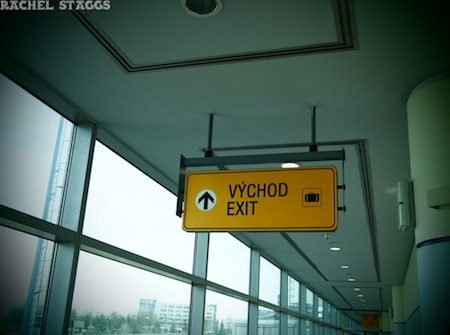
“Aha,” I said. “They use východ for “east” not because that's where the sun comes up but because that's where it enters…”
“…”
“Uh…”
No. Entrance is not exit. Východ is exit. Entrance is vchod.
I dunno, man. I love the Czechs, but this is a little messed up.
Addenda
I think I recall that sever, “north”, is thought to be maybe akin to “shower”, since the north is whence the cold rains come, but maybe I made that up.
- Late update: Nope, I just found that I mentioned the same thing in this earlier article about compass directions. ]
An earlier version of this article had an error about the Catalán. Thanks to Alex Corcoles for pointing this out.
I never mentioned the other Czech compass points. They are: sever, north; východ, east, západ, west, jih, south. Východ seems to be related to Russian восто́к (/vostók/) but I'm not sure how.
20231220: A Gentle Reader asked about the pronunciation of vchod as compared with východ. Is it some unpronounceable Czechism? Nope! I was very pleased with the analogous example I found: the difference is no harder to hear or to say than the difference between “climb” and “keylime”.
[Other articles in category /lang/etym] permanent link
Sat, 02 Dec 2023Content warning: grumpy complaining. This was a frustrating month.
Need an intuitive example for how "P is necessary for Q" means "Q⇒P"?
This kind of thing comes up pretty often. Why are there so many ways that the logical expression !!Q\implies P!! can appear in natural language?
- If !!Q!!, then !!P!!
- !!Q!! implies !!P!!
- !!P!! if !!Q!!
- !!Q!! is sufficient for !!P!!
- !!P!! is necessary for !!Q!!
Strange, isn't it? !!Q\land P!! is much simpler: “Both !!Q!! and !!P!! are true” is pretty much it.
Anyway this person wanted an intuitive example of “!!P!! is necessary for !!Q!!”
I suggested:
Suppose that it is necessary to have a ticket (!!P!!) in order to board a certain train (!!Q!!). That is, if you board the train (!!Q!!), then you have a ticket (!!P!!).
Again this follows the principle that rule enforcement is a good thing when you are looking for intuitive examples. Keeping ticketless people off the train is something that the primate brain is wired up to do well.
My first draft had “board a train” in place of “board a certain train”. One commenter complained:
many people travel on trains without a ticket, worldwide
I was (and am) quite disgusted by this pettifogging.
I said “Suppose that…”. I was not claiming that the condition applies to every train in all of history.
OP had only asked for an example, not some universal principle.
Does ...999.999... = 0?
This person is asking one of those questions that often puts Math StackExchange into the mode of insisting that the idea is completely nonsensical, when it is actually very close to perfectly mundane mathematics. (Previously: [1] [2] [3] ) That didn't happen this time, which I found very gratifying.
Normally, decimal numerals have a finite integer part on the left of the decimal point, and an infinite fractional part on the right of the decimal point, as with (for example) !!\frac{13}{3} = 4.333\ldots!!. It turns out to work surprisingly well to reverse this, allowing an infinite integer part on the left and a finite fractional part on the right, for example !!\frac25 = \ldots 333.4!!. For technical reasons we usually do this in base !!p!! where !!p!! is prime; it doesn't work as well in base !!10!!. But it works well enough to use: If we have the base-10 numeral !!\ldots 9999.0!! and we add !!1!!, using the ordinary elementary-school right-to-left addition algorithm, the carry in the units place goes to the tens place as usual, then the next carry goes to the hundreds place and so on to infinity, leaving us with !!\ldots 0000.0!!, so that !!\ldots 9999.0!! can be considered a representation of the number !!-1!!, and that means we don't need negation signs.
In fact this system is fundamental to the way numbers are represented in computer arithmetic. Inside the computer the integer !!-1!! is literally represented as the base-2 numeral !!11111111\;11111111\;11111111\;11111111!!, and when we add !!1!! to it the carry bit wanders off toward infinity on the left. (In the computer the numeral is finite, so we simulate infinity by just discarding the carry bit when it gets too far away.)
Once you've seen this a very reasonable next question is whether you can have numbers that have an infinite sequence of digits on both sides. I think something goes wrong here — for one thing it is no longer clear how to actually do arithmetic. For the infinite-to-the-left numerals arithmetic is straightforward (elementary-school algorithms go right-to-left anyway) and for the standard infinite-to-the-right numerals we can sort of fudge it. (Try multiplying the infinite decimal for !!\sqrt 2!! by itself and see what trouble you get into. Or simpler: What's !!4.666\ldots \times 3!!?)
OP's actual question was: If !!\ldots 9999.0 !! can be considered to represent !!-1!!, and if !!0.9999\ldots!! can be considered to represent !!1!!, can we add them and conclude that !!\ldots 9999.9999\ldots = 0!!?
This very deserving question got a good answer from someone who was not me. This was a relief, because my shameful answer was pure shitpostery. It should have been heavily downvoted, but wasn't. The gods of Math SE karma are capricious.
Why define addition with successor?
Ugh, so annoying. OP had read (Bertrand Russell's explanation of) the Peano definition of addition, and did not understand it. Several people tried hard to explain, but communication was not happening. Or, perhaps, OP was more interested in having an argument than in arriving at an understanding. I lost a bit of my temper when they claimed:
Russell's so-called definition of addition (as quoted in my question) is nothing but a tautology: ….
I didn't say:
If you think Bertrand Russell is stupid, it's because you're stupid.
although I wanted to at first. The reply I did make is still not as measured as I would like, and although it leaves this point implicit, the point is still there. I did at least shut up after that. I had answered OP's question as well as I was able, and carrying on a complex discussion in the comments is almost never of value.
Why is Ramanujan considered a great mathematician?
This was easily my best answer of the month, but the question was deleted, so you will only be able to see it if you have enough Math SE reputation.
OP asked a perfectly reasonable question: Ramanujan gets a lot of media hype for stuff like this:
$${\sqrt {\phi +2}}-\phi ={\cfrac {e^{{-2\pi /5}}}{1+{\cfrac {e^{{-2\pi }}}{1+{\cfrac {e^{{-4\pi }}}{1+{\cfrac {e^{{-6\pi }}}{1+\,\cdots }}}}}}}}$$
which is not of any obvious use, so “why is it given such high regard?”
OP appeared to be impugning a famous mathematician, and Math SE always responds badly to that; their heroes must not be questioned. And even worse, OP mentioned the notorious non-fact that $$1+2+3+\ldots =-\frac1{12}$$ which drives Math SE people into a frothing rage.
One commenter argued:
Mathematics is not inherently about its "usefulness". Even if you can't find practical use for those formulas, you still have to admit that they are by no means trivial
I think this is fatuous. OP is right here, and the commenter is wrong. Mathematicians are not considered great because they produce wacky and impractical equations. They are considered great because they solve problems, invent techniques that answer previously impossible questions, and because they contribute insights into deep and complex issues.
Some blockhead even said:
Most of the mathematical results are useless. Mathematics is more like an art.
Bullshit. Mathematics is about trying to understand stuff, not about taping a banana to the wall. I replied:
I don't think “mathematics is not inherently about its usefulness" is an apt answer here. Sometimes mathematical results have application to physics or engineering. But for many mathematical results the application is to other parts of mathematics, and mathematicians do judge the ‘usefulness’ of results on this basis. Consider for example Mochizuki's field of “inter-universal Teichmüller theory”. This was considered interesting only as long as it appeared that it might provide a way to prove the !!abc!! conjecture. When that hope collapsed, everyone lost interest in it.
My answer to OP elaborated on this point:
The point of these formulas wasn't that they were useful in themselves. It's that in order to find them he had to have a deep understanding of matters that were previously unknown. His contribution was the deep understanding.
I then discussed Hardy's book on the work he did with Ramanujan and Hardy's own estimation of Ramanujan's work:
The first chapter is somewhat negative, as it summarizes the parts of Ramanujan's work that he felt didn't have lasting value — because Hardy's next eleven chapters are about the work that he felt did have value.
So if OP wanted a substantive and detailed answer to their question, that would be the first place to look.
I also did an arXiv search for “Ramanujan” and found many recent references, including one with “applications to the Ramanujan !!τ!!-function”, and concluded:
The !!\tau!!-function is the subject of the entire chapter 10 of Hardy's book and appears to still be of interest as recently as last Monday.
The question was closed as “opinion-based” (a criticism that I think my answer completely demolishes) and then it was deleted. Now if someone else trying to find out why Ramanujan is held in high regard they will not be able to find my factual, substantive answer.
Screw you, Math SE. This month we both sucked.
[Other articles in category /math/se] permanent link
Fri, 01 Dec 2023
Obsolete spellings and new ligatures in the names of famous persons
There's this technique you learn in elementary calculus called l'Hospital's rule or l'Hôpital's rule, depending on where and when you learned it. It's named for Guillaume l'Hospital or Guillaume l'Hôpital.
In modern French the ‘s’ is silent before certain consonants, and sometime in the 18th century it became standard to omit it, instead putting a circumflex over the preceding vowel to show that the ‘s’ was lurking silently. You can see the same thing in many French words, where the relationship with English becomes clear if you remember that the circumflex indicates a silent letter ‘s’. For example
- côte (coste, coast)
- fête (feste, feast)
- île (isle, isle)
- pâté (paste, paste)
and of course
- hôpital (hospital, hospital)
But the spelling change from ‘os’ to ‘ô’ didn't become common until the 18th century and l'Hôpital, who died in 1704, spelled his name the old way, as “l'Hospital”. The spelling with the circumflex is in some sense an anachronism. I've always felt a little funny about this. I suppose the old spelling looks weird to francophones but I'm not a francophone and it seems weird to me to spell it in a way that l'Hospital himself would not have recognized.
For a long time I felt this way about English names also, and spelled Shakespeare's name “Shakspere”. I eventually gave up on this, because I thought it would confuse people. But I still think about the question every time I have to spell it and wonder what Shakespeare would have thought. Perhaps he would have thought nothing of it, living as he did in a time of less consistent orthography.
To find out the common practice, I went to the German Wikipedia page for Karl Gauss, for whom there a similar issue arises. They spell it the modern way, “Gauß”. But now another issue intrudes: They spell it “Carl” and not “Karl”! If the name were completely modernized, wouldn't it be “Karl Gauß” and not “Carl Gauß”? Is “Carl” still a thing in German?
Gauss is glowering down at me from his picture on an old ten-mark banknote I keep on my wall, so I checked just now and Deutsche Bundesbank also spells it ”Carl Gauß”. (The caption sprouts forth from his left shoulder.)
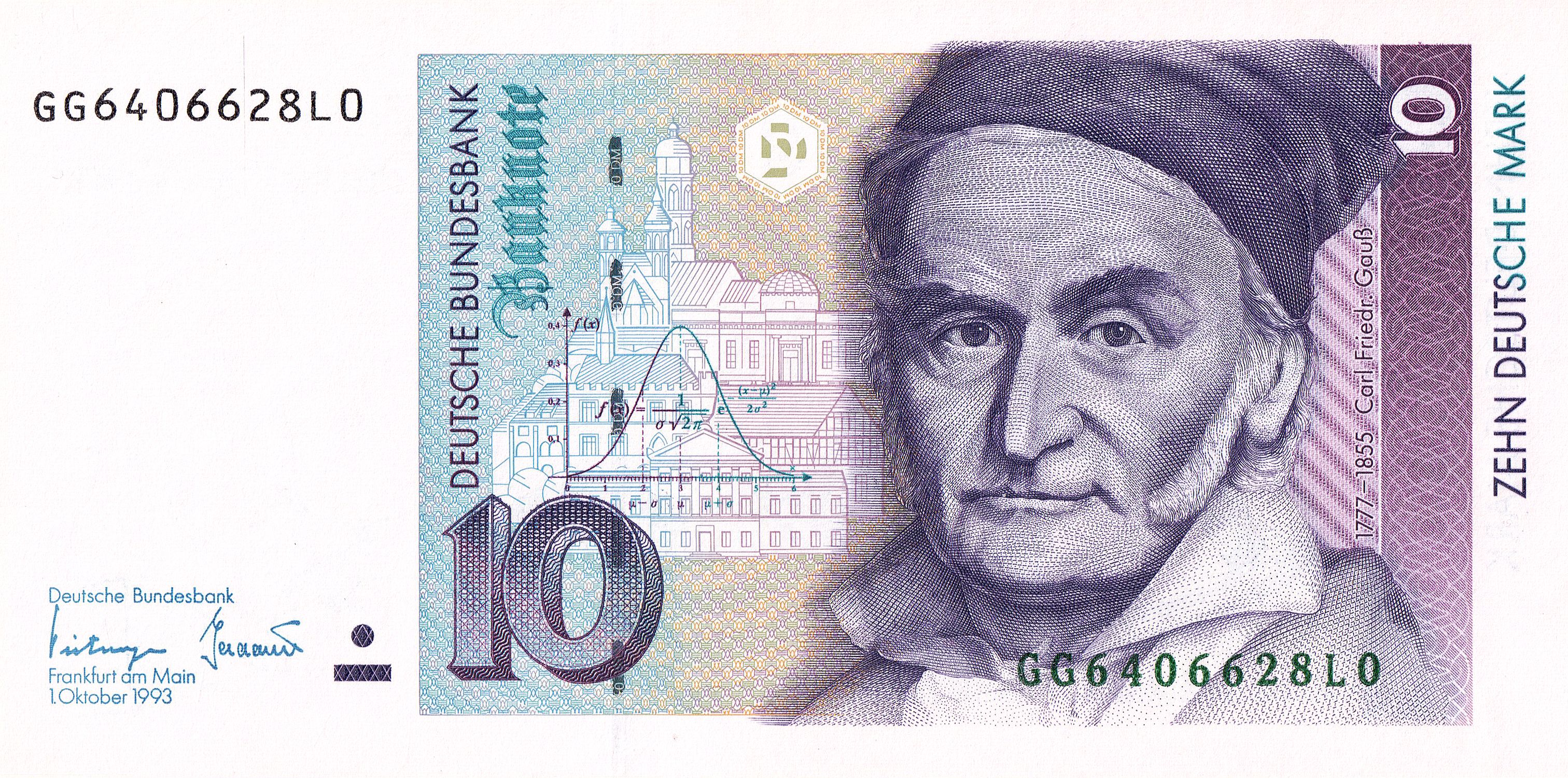
Now I wonder why I checked the German Wikipedia for Gauss before checking the French Wikipedia for l'Hôpital. Pure stupidity on my part. French Wikipedia uniformly spells it the modern way, with the circumflex.
I suppose I will have to change my practice, and feel the same strangeness whenever I write “Gauß” or “l'Hôpital” as I do when I write “Shakespeare”.
Addenda
Math SE search for l'Hôpital produces 9,336 hits including many that omit the ‘s’ entirely, “l'Hopital”. A search for l'Hospital produces a surprisingly large 5,593 hits.
I also consulted the Chicago Manual of Style but found nothing helpful.
I once knew a graduate student named Chris Geib, who explained to me that his German ancestors had probably been named “Geiß” (“goat”) but that the ẞ was misinterpreted at some point.
[Other articles in category /lang] permanent link