


Sun, 23 Jun 2024
A potpourri of cool-looking scripts
A few months ago I noticed the banner image of Mastodon user
@emacsomancer@types.pl:
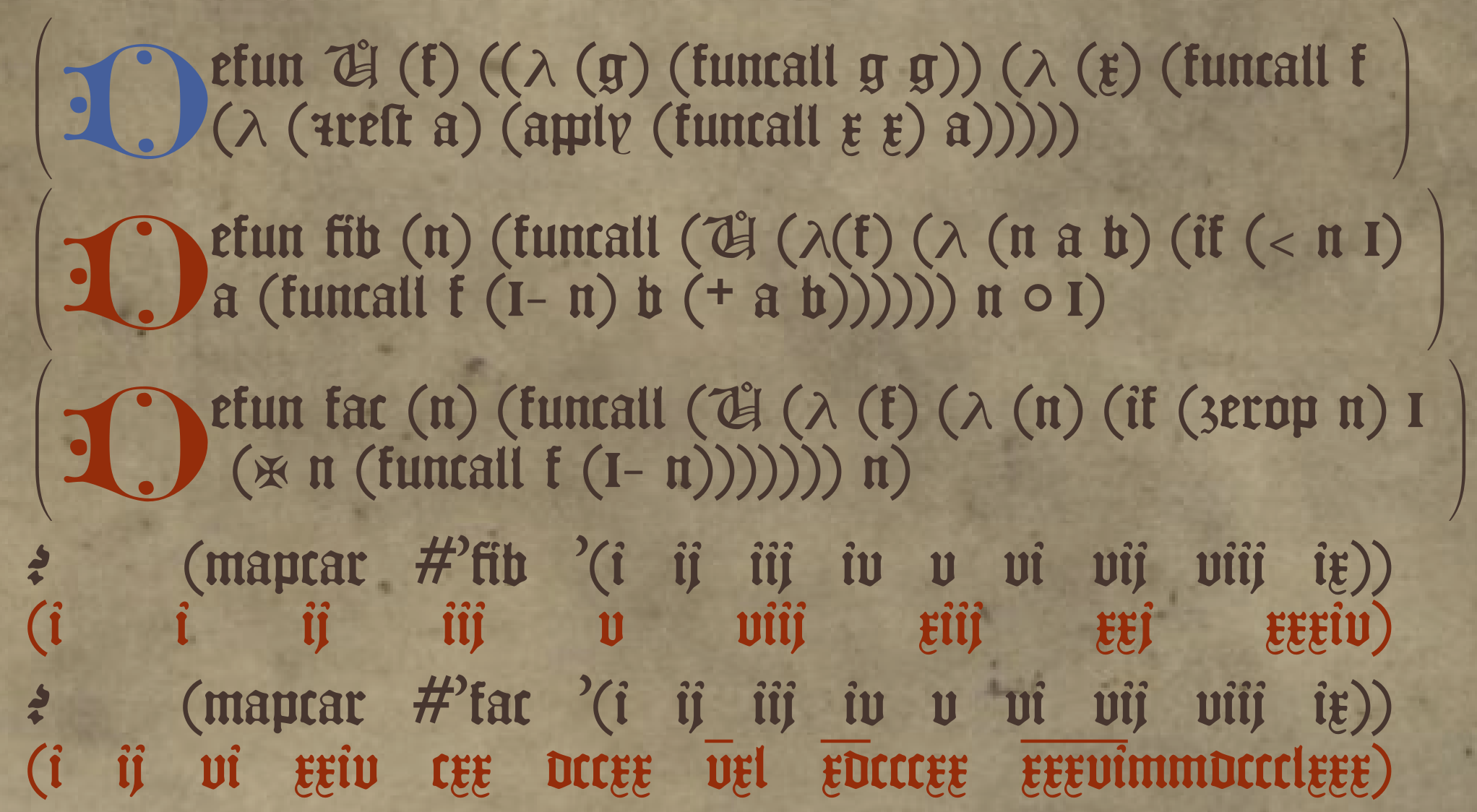
I had two questions about this. First where is it from and is there
more? @emacsomancer pointed me to
the source Github repository
and also to
this magnificent hand-lettered interpretation of it
by artist Michał "phoe" Herda, who is also
an author of books about Lisp.
My other question was more particular: The graphic renders Roman numerals 1, 2, 3, 6, 7, and 8 as i, ij, iij, vi, vij, and viij, respectively. The trailing j's are historically accurate. Medieval accounts often rendered the final 'i' in a Roman numeral as a 'j', to make it harder to alter the numeral by adding more i's on the end. I wondered why the graphic had done this for 2, 3, 7, and 8, but not for 1 or 6. I thought that 1 should have been 'j' and 6 should have been 'vj', but I wasn't certain. Was I remembering wrong?
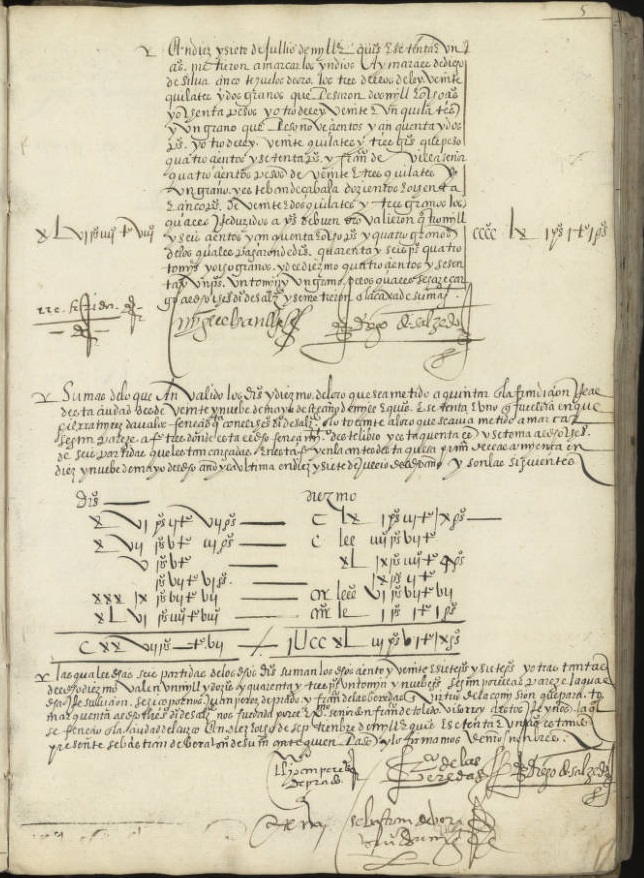
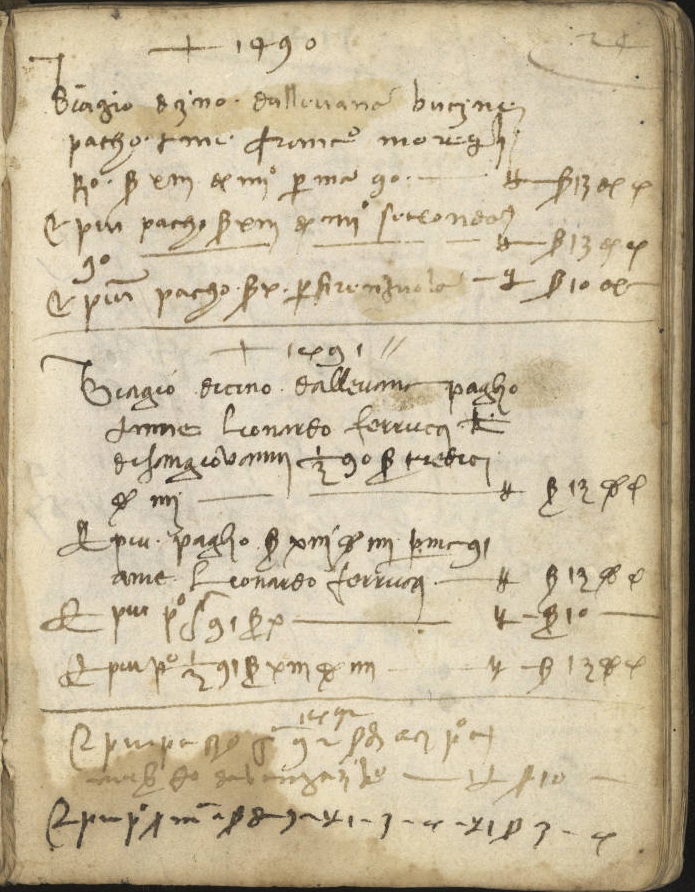
With the continuing debasment of Google search, it was much more difficult than it should have been to find an example of a medieval ledger that contained the numbers I wanted. I eventually succeeded: 1 and 6 were written as 'j' and 'vj' as I remembered. But while looking for what I wanted, and while doing similar-image search for the original graphic, I ran into a lot of very handsome and intriguing pictures. Some of these are below.
Medieval Ledgers and Account Books
These are beautiful, but what I really wanted were just dense, boring columns of numerals. Still, wow!
https://sites.temple.edu/historynews/2018/11/30/medieval-collections-ledgers-and-account-books/
Tironian notes
I believe this next item is from a glossary of Tironian notes, which was a shorthand system named for (and perhaps originated by) Tiro, the personal secretary of Cicero, and which persisted into the Middle Ages.
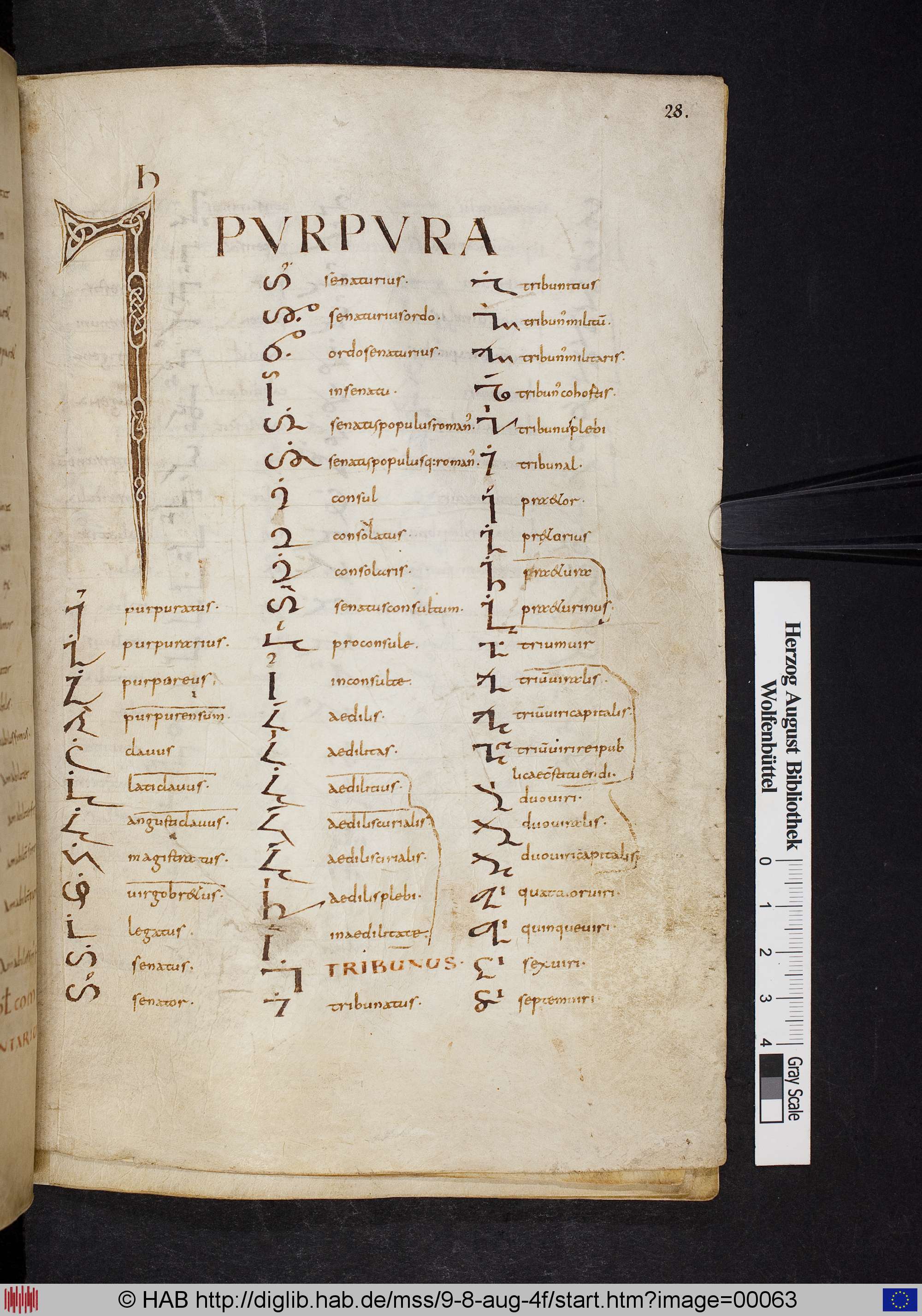
I do not understand how the glossary was organized — certainly it is not alphabetized. By subject, perhaps? The page is headed PURPURA ("purple") and it does seem to have a number of purple-related words. It also has entries for 'senatus', 'senator', and 'senatus populusque romanus', and for Roman elected offices 'aedilis', 'consul' and 'proconsul', 'tribunus', and so on. Important people in Rome wore togas edged in purple, so I guess the PURPURA heading is metonymic.
I have no idea how anyone could be expected to memorize these several thousand seemingly arbitrary squiggles. I guess it's something to do with your time if you can't play Skyrim.
https://blogs.bl.uk/digitisedmanuscripts/writing/page/2/
https://blogs.bl.uk/.a/6a00d8341c464853ef0240a4733253200c-pi
Kiev Missal
This is the beginning of the Kiev Missal, which Wikipedia describes as:
a seven-folio Glagolitic Old Church Slavonic canon manuscript containing parts of the Roman-rite liturgy. It is usually held to be the oldest and the most archaic Old Church Slavonic manuscript, and is dated at no later than the latter half of the 10th century.
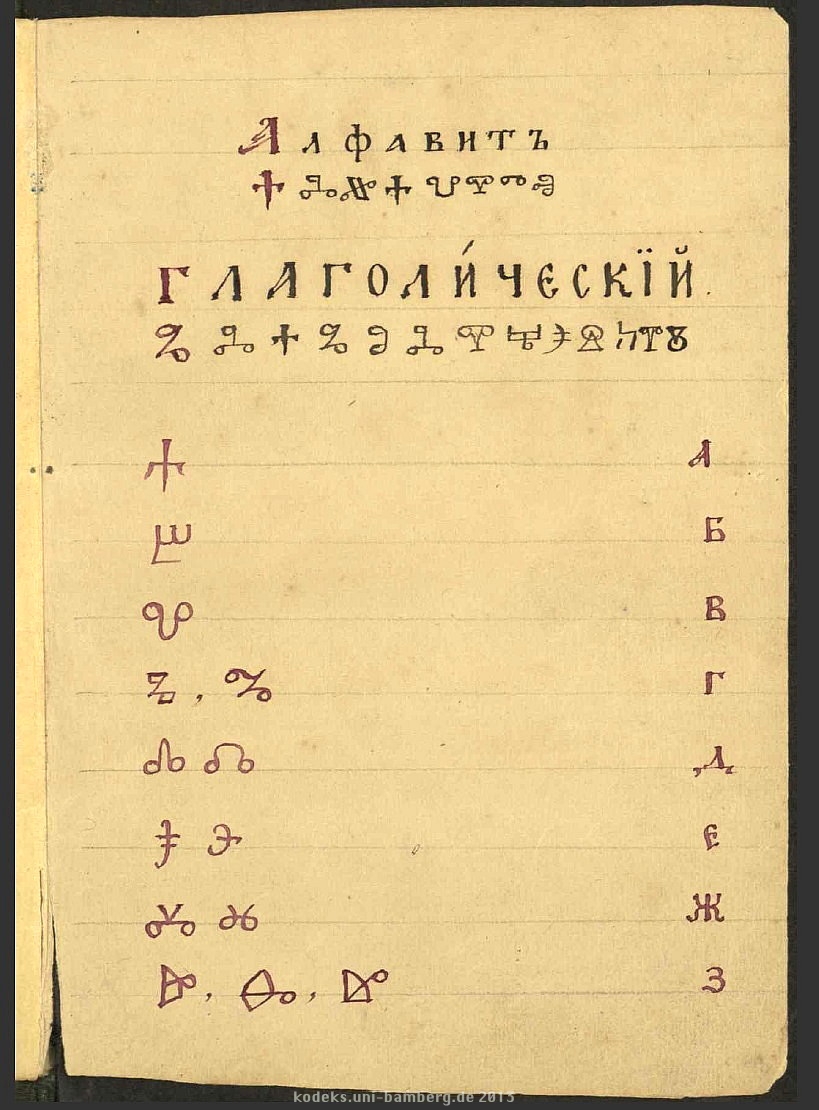
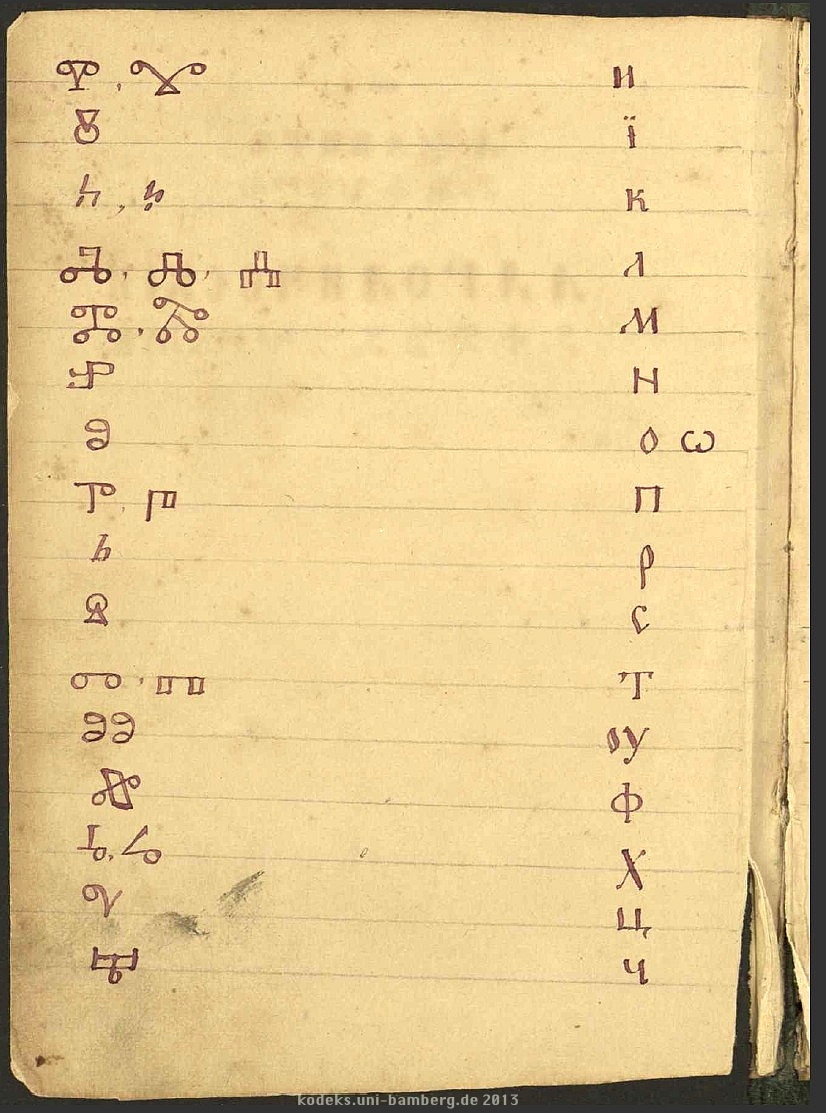
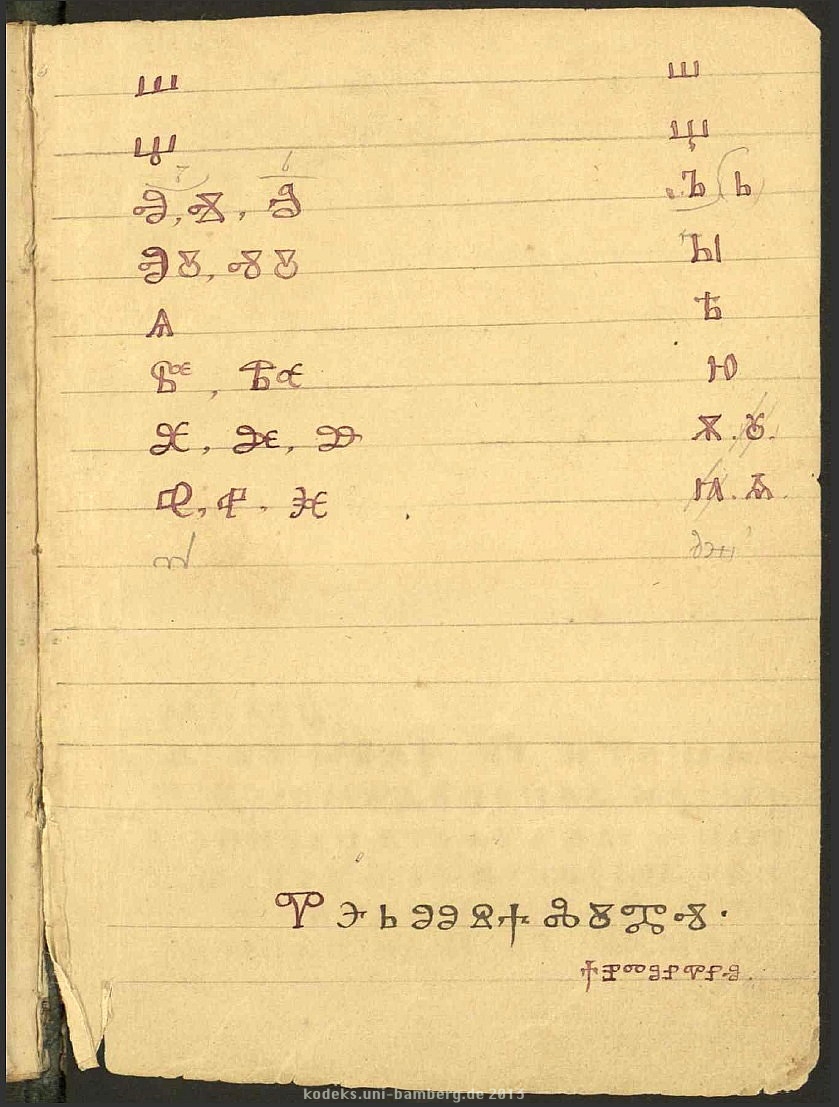
These front matter pages are a key for transliterating between the Glagolitic script (on the left) and the Cyrillic (on the right). I looked at the pages in reverse order, recognized the Cyrillic on the third page right away, and then frowned at the symbols on the left site. "What is that?" I asked myself. "Is that Glagolitic?" Then I moved on and saw the title on page 1, which says:
Алфавиты ГЛАГОЛИ́ЧЭСКІЙ
That is, "Alphavety GLAGOLÍTSÈSKÏJ". Right! I was pleased, and thought that if the fifteen-year-old version of me could see this he would think he had turned out okay.
https://kodeks.uni-bamberg.de/aksl/Texte/KievFolia.htm
Theban Alphabet
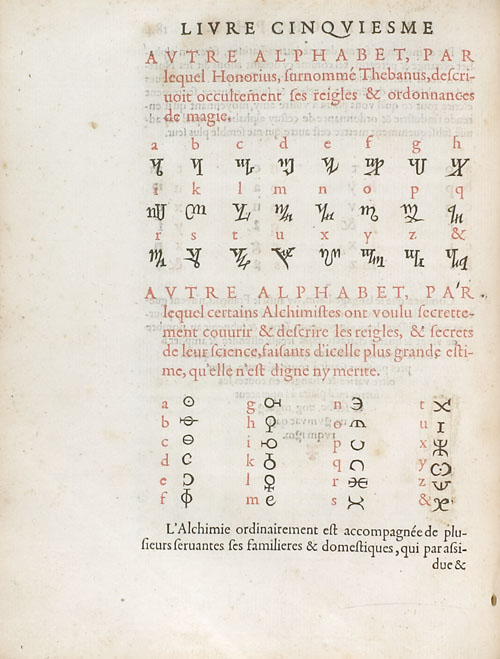
This looked cool but turned out to be less interesting than I hoped. It is the so-called Theban Alphabet, which is not actually from Thebes. It is also called the Witches' alphabet, to make it sound cool. The original source is a 1518 book called Polygraphia which contains thousands of such scripts, all made up by the author, for some cryptographic purpose that is not clear to me. If someone wanted a set of funny squiggles to replace the letters of the alphabet, why would they need his book? Why wouldn't they just make some up?
(Image below from https://en.wikipedia.org/wiki/File:NyctoFrenchPolygraphia.jpg.)

Pinterest Theban Alphabet
Following up on the Theban alphabet, Gooogle gave me a link to a page about it from Pinterest. I usually ignore these, mainly because Pinterest is a walled garden that will show me thumbnails to get me interested, but won't let me click through without an account. In fact I sometimes run a browser extension that strips Pinterest from my image search results. This time though the aggregated thumbnails were cool-looking enough that I decided to save them.

Individually some of these look interesting and deserving of followup. Not the witchcraft sigils though. Witchcraft and demonology are dead ends. Demonological tomes are always a combination of nonsense that the author pulled out of their ass, or reverent repetitions of something that they read in an earlier demonological tome that an earlier author pulled out of their ass.
[Other articles in category /lang] permanent link