


Wed, 29 Jul 2026
The road to epsilon-zero: Infinite Nim as a coin-moving game
Previously:
- Ordinal numbers and basic set theory
- Ordinals as nim-heaps
- Nim always ends, even with infinite ordinals
In the previous articles I talked about the game of Nim, a very simple game for two players:
- There are some piles of beans
- Players alternate turns
- A legal move is to take any number of beans from one pile
- Whoever takes the last bean wins
I wrote about how Nim could be extended to include certain types of “infinite” piles while still remaining a sensible game. This involved introducing green tokens that could be replaced with any number of beans, then square tokens that could be replaced with any number of green tokens and beans, and so on.
Rather than think about an infinite family of different kinds of tokens, there's a simple way to make them all the same sort of thing.
Imagine a game where the board is a track of squares, extending to the right (and to the right only) as far as needed. Let's number the squares: the leftmost one is !!0!!, then !!1, 2, 3, \dots!! and so on.

On some of the squares are coins. In this game, a player's legal moves are to take one coin and move it some number of squares to the left. Coins don't interfere with one another; any number of coins may occupy a single space. As in Nim, the player who is able to make the last legal move wins. In Nim that means taking the last bean; in this game it means moving the last coin to the !!0!! square.
This game is nothing but Nim, in a different form. A Nim game with piles of !!2, 2, 3, 5, !! and !!6!! beans is exactly equivalent to the strip game, with coins on squares !!2, 2, 3, 5, !! and !!6!!.

Removing four beans from a pile is isomorphic to moving a coin four squares leftward.
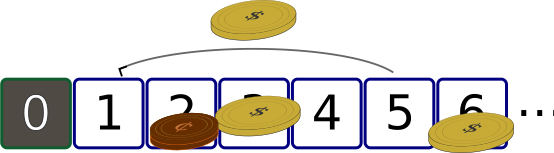
A coin on square zero behaves like an empty pile of beans — no further moves are possible for that coin / pile, and it has no further effect on the game.
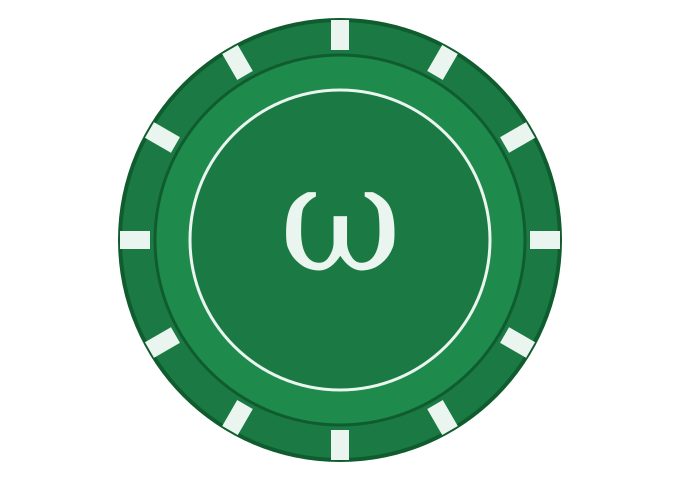
In Nim, we represented !!ω!! with a green token that could be replaced with any number of beans:
In the strip game, we don't need special tokens. We represent !!ω!! by adding a second strip, atop the first:
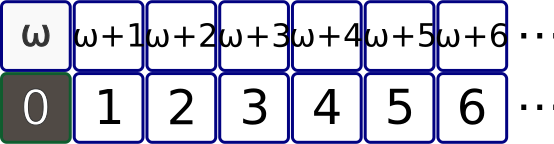
and the rule that a coin in the upper strip can be moved to the left or to any space in the lower strip:
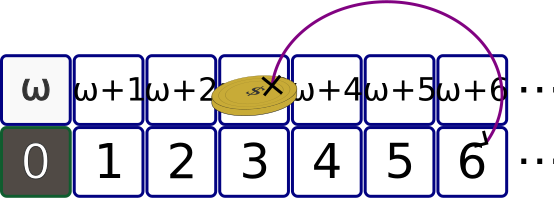
The picture above shows how to take all but six beans from a pile of !!ω+3!!.
Adding more strips gets us easily almost to !!ω²!!:
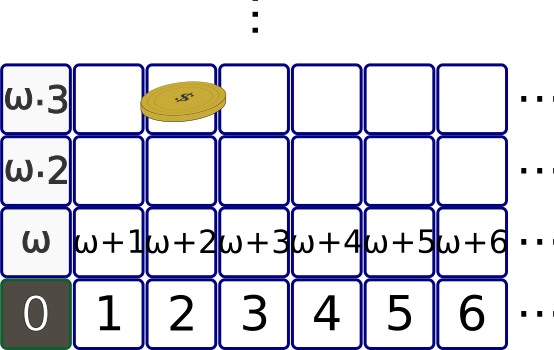
The coin here represents a pile of !!ω·3 + 2!! beans.
If we were to stack a second grid on top of this one, and then add the rule that a coin in the upper grid can be moved to any square in the lower grid, then the lower-leftmost square in the upper grid would be equivalent to a pile of !!ω^2!! beans, and the other squares in the upper grid would be variouls ordinals of the form !!ω^2 + ω·b + c!!. Adding a third grid would get us up to !!ω^2·2 + ω·b + c!!, and a whole infinite stack of grids would get us an infinite cube that would almost take us to !!ω^3!!.
We could then build an infinite four-dimensional stack of cubes to get to !!ω^3!! and beyond, and so on to infinite dimensions, and that's the construction I had in mind when I said !!ω^ω!! was where the ordinals start to get scary. But there's an easier way to proceed, which we'll see in the next article.
Coming next:
And then:
- Productive programs and well-founded orders
- Shortlex order also orders sequences of numbers
- “Shortlex” isn't actually a single order
[Other articles in category /math/ordinals] permanent link
Mon, 27 Jul 2026
“Steph Curry: fluke or breakthrough” ten years later
Flukes and Breakthroughs
In the NBA 2015–16 season, Steph Curry set the all-time single-season record for three-point field goals, 402, completely crushing the old record of 286. Curry's record still stands.
The New York Times was rather breathless about this:
The record is an outlier that defies most comparisons, but here is one: It is the equivalent of hitting 103 home runs in a Major League Baseball season.
And it is an astonishing feat. But I wrote an article called Steph Curry: fluke or breakthrough? in which I compared Curry's feat with similar feats of the past, including the one implied by the Times, Babe Ruth's 1920 single-season home run record, and concluded:
To make the same comparison as the authors of the Times article, [Ruth's feat] is the equivalent of hitting 136 home runs in a Major League Baseball season.
I also compared Curry's record with Joe Dimaggio's 1941 hitting streak, Bob Beamon's world record long jump at the 1968 Olympic Games, and Takeru Kobayashi's decade-long domination of competitive hot dog eating. I analyzed these as being of two types: mere flukes, which were never repeated, and breakthroughs, in which the athlete discovered a new technique or approach that radically transformed the sport itself. DiMaggio and Beamon's feats, I said, were flukes, but Ruth's and Kobayashi's were breakthroughs.
At the end I asked the obvious question: was Steph Curry's new three-point field goal record a fluke, or a breakthrough? I guessed that it would turn out to have been a breakthrough.
I predicted:
Unless the league tinkers with the rules to prevent it, we might expect the next generation of players to regularly lead the league with 300 or 400 three-point shots in a season. … I think it's likely that we'll see basketball enter a new era of higher offense with more three-point shots, and that future sport historians will look back on this season as a watershed.
I've remarked more than once that I don't like trying to predict the future:
I don't think I'm good at it and I don't think anyone else is. Most people who try don't seem to revisit their old predictions to see if they were correct, or to learn from their past errors, and the people who listen to them never do this.
I don't know much about basketball, but having made a clear prediction, I owe it to myself and my Gentle Readers to revisit the prediction to see if I was correct.
The data
I went to Basketball Reference and pulled their list of the 250 player-seasons with the largest number of three-pointers, then asked Claude to turn it into a chart:
Each dot is one player in one season. Hovering on a dot shows you the player to whom it belongs. The !!x!!-axis shows the year in which each season ended, the !!y!!-axis the number of three-pointers the owner recorded in that season. The blue diamonds are Curry's, gray dots are everyone else's. The vertical blue hairline at the 2015–16 season intersects Curry's all-time record of 402 three-pointers, aftyer which I wrote the original article.
You can see a surprising jump in three-pointers in the three seasons of 1994–95 through 1996–97. In those seasons the league moved the three-point line closer to the basket, moving it back again in 1997–98. In the rest of this article I will ignore these.
The verdict
Was I right when I said the Curry's 402 would turn out to have been a breakthrough? I think yes.
Looking at the dots on the chart, it's quite clear that something changed. Up to 2015, the total of 250 was exceeded just six times: four times by Curry and once each by Ray Allen and Klay Thompson. (Remember we're ignoring 1995–7 when the rules were changed.) But after 2015, that total was achieved 34 times in 10 seasons, by 19 different players.
I got some details wrong. I guessed:
we might expect the next generation of players to regularly lead the league with 300 or 400 three-point shots in a season.
This hasn't happened. Last season Anthony Edwards led the league with 320, but this season's record, 273 by Kon Knueppel, is much more typical. Only Curry himself has regularly exceeded 300.
On the other hand, regarding Ruth, I pointed out:
Ruth's innovation was promptly imitated. In 1920, the #2 hitter hit 19 home runs and the #10 hitter hit 11, typical numbers for the nineteen-teens. By 1929, the #10 hitter hit 31 home runs, which would have been record-setting in 1919.
And something like this has happened. This season, the #10 players each hit 224 three-pointers. These would have led the league in all but two years prior to 2012–13. Before Curry, the all-time record was 269 (Ray Allen, 2005–06); two players exceeded that this year and three last year.
Was it “a different game”?
Regarding the decade following the watershed 1920 baseball season, I said:
It was a different game.
And it really seems like this hasn't happened in baskeball. Players are certainly attempting and making more three-point shots, but they haven't taken over the league the way sluggers did in the 1920s.
| Season | Attempts | Success | Success % | 3P points | Total points | 3P fraction |
|---|---|---|---|---|---|---|
| 2015–16 | 59,241 | 20,953 | 35.4 % | 62,859 | 252,572 | 24.9 % |
| 2025–26 | 90,970 | 32,717 | 36.0 % | 98,151 | 284,395 | 34.5 % |
| (comparison) | +54 % | +56 % | +56 % | +12.6 % |
(Source: Basketball Reference 2015–16 season 2025–26 season)
Total 3PFG attempts are up by 31,729, of which 11,765 succeeded, producing 35,295 points. Total points were up by less than this, 32,823 — the three-pointers are cannibalizing some of the other scoring opportunities.
In 2016 I observed:
Curry didn't get lucky this year; he had 40% more field goals because he made almost 40% more attempts.
I concluded from this that Curry could continue to shoot more three-pointers just by making more attempts, and that other players might similarly shoot more three-pointers by making more attempts. This turned out to be correct. Success rates haven't increased, attempts have. Just looking at attempts is misleading because players seem to be playing fewer games than they were in 2015–16. But the league leaders in three-pointers per game are generally up over 2015–16. In that season, three players averaged over three three-pointers per game (with Curry running away with 5.1). This season, there were 13, and Luka Dončić hit 4.0.
On the other hand
I ended the previous article by saying:
I think it's likely that we'll see basketball enter a new era of higher offense with more three-point shots, and that future sport historians will look back on this season as a watershed.
The reasons I gave still seem solid, and I think this was basically right. Over the last ten years I've read several articles complaining about how reliance on the three-point shot is ruining basketball:
(It's fun to compare this with the similar complaints from the past hundred years about home runs. There was a batch in the 1920s, and then another crop in the years following 1998 when Sosa and McGwire both broke the single-season home-run record.)
And Wikipedia has an article on the three-point revolution with links to recent news articles with titles like “Three-point shooting in the NBA is more extreme than ever” and “The NBA's 3-point craze is only getting crazier”.
Addendum 20260915
Dan Luu points out a major aspect of all this that I completely missed. I said:
Success rates haven't increased, attempts have.
The obvious explanation for this is that defense has adapted.
I think missed this for two reasons. First, I don't actually watch basketball games, I only look at statistics. And second, I was too attached to the home runs analogy. But a home run in baseball is a very unusual thing, perhaps unique in sport: it cannot be defended against.
[Other articles in category /games] permanent link
Sun, 19 Jul 2026
The road to epsilon-zero: Nim always ends, even with infinite ordinals
Previously:
[Yesterday][prev-2] I talked about the game of Nim, which involves two players taking beans from several piles, and an extension that includes green tokens that behave a bit like infinite piles:
When there's a pile with one or more green tokens, it's legal for a player to remove any or all of them, and then to add any number of beans to the pile.
At first it might seem that Nim with !!ω!!-tokens could go on forever. Not so!
If someone gives you a Nim position where all the piles contain beans, you can say ahead of time how long the game might last. A game starting with nim-heaps of size !!\{1, 3, 4, 8\}!! simply can't last more than 16 turns, because each turn removes at least one bean from a pile, and the game ends when someone takes the last bean.
If the game starts with nim-heaps of size !!\{1, 3, 4, 8, \omega\}!!, you can't know how long it might last. If you guess it will be over in !!1,\!000!! turns, the first player might prove you wrong by replacing the !!\omega!!-token with a pile of !!10,\!000!! beans, and then the game might last up to !!10,\!016!! more turns.
If you guessed at the start that the game would last no more than !!10,\!016!! turns, one of the players might replace the token with a pile of !!1,\!000,\!000,\!000,\!000,\!000,\!000!! beans, or even more. Before the first move, there is no bound that can be placed on how long the game will take to finish.
But what you can say about !!\{1, 3, 4, 8, \omega\}!! is that after at most !!17!! moves, someone will have removed the !!ω!!-token and replaced it with some finite number of beans. And that that point you'll be able to say when the game will end.
!!ω·2!!
Similarly, suppose there is are piles !!\{1, 3, 4, 8, \omega·2\}!!. Remember that !!\omega·2!! is simply a stack of two green tokens. What's the longest this game could last?
As before, we can't say. But we can say that after at most !!17!! turns, at least one of the !!ω!! tokens will have been removed, and there will be at most one !!ω!! token and a possibly very large number of beans, say !!b_1!!. And then after at most !!b_1+1!! more moves, the last !!ω!! token will have been taken if it wasn't before, and only beans will be left, possibly a very large number of beans, say !!b_2!!.
And at that point we will be certain that the game can't last more than !!b_2!! more moves.
So with !!\{1, 3, 4, 8, \omega·2\}!! we can't say how long the game will take to finish.
And we can't say when we will be able to say how long the game will take to finish.
But we can say that in at most !!17!! moves, we will be able to say, not how long the game will take to finish, but how long it will be before we can say how long the game will take to finish.
Estimating programming tasks
This reminds me of a story I once heard from another programmer. He told me his boss had come to him to ask him if he could fix a certain bug. He had replied that he could, and the boss had asked him how long he thought it would take.
He said “I don't know, I have to think about it.”
His boss, being a reasonable woman, asked him when he would be able to tell her.
Again he said “I don't know, I have to think about it.”
The boss, having dealt with this guy before, did not lose her temper. Instead, she asked how long it would take him to figure that out.
“Not more than two days,” he said at once.
“Okay,” she said. “Just to make sure there is no miscommunication, are you telling me that in two days you may not be able to estimate the task, but you will be able to tell me when the estimate will be ready?”
“That's right.”
And they parted amicably, both parties satsified, at least for the time. Communication between management and engineering doesn't always turn out so well!
My friend was apaprently playing the game !!ω·2+1!!. There was only one bean, so one of the !!ω!! tokens would have to have gone by the second day. At that point there would remain !!ω + n!! for some finite number !!n!!, and although my friend wouldn't be able to say at that point how long the game would last, he would know that he would be able to deliver the estimate after at most !!n+1!! more days.
The game must end!
With !!ω·2+1!! we don't know when the game will end, or how long it will be before we know when the game will end.
But we do know that in at most two moves we will know how long it will be before we know how long it will be before the game ends, and that means that we do know that that game will end even though we're quite far away from saying when that will happen.
The argument is always the same: there are only a finite number of beans, and even if both players try to avoid the tokens, the beans will eventually run out and someone will be forced to replace a green token with more beans. Then those beans will run out and someone will be forced to take another token, and so on, until all the tokens are gone, and then when the beans run out the game is over.
Of course, both tokens and beans might go faster than that. But go they will, however slowly and even if only one at a time.
And this is true no matter how many green !!ω!! tokens there are to begin with.
And the same holds true if there are any square !!ω^2!! tokens. Even if the players avoid the square tokens, at some point all the beans and green !!ω!! tokens will be used up and someone will have to replace at least one square !!ω^2!! token with more beans and green tokens, and then those will be used up… and eventually the last square !!ω^2!! token will be gone, and then we're back to the !!ω·n+m!! case of the previous paragraph and the game must end.
But at that point we have defeated English descriptions. We have piled up an infinite sequence of “how long before we can say”s into “We can't say how long before we can say … how long before the game ends”.
Bizarre! And yet we know that even these games must end, although English isn't powerful enough to say how long it will take, or even how long before we will be able to say how long it will take.
Ordinals are well-founded
An ordinal is a set of smaller ordinals. Every move in Nim makes an ordinal smaller. If you keep making numbers smaller you eventually reach 0, and then the game is over.
This property of ordinals is called well-foundedness. We say that ordinals are well-founded.
Note that this that this is a special property of ordinals, not shared by all types of numbers. For example, the positive rational numbers do not have this property. From !!1!! you can go down to the smaller !!\frac12!!, then to the smaller !!\frac13!!, and so on, downward, always downward to smaller and smaller numbers, but never reaching zero. A game of Nim where the beans can be divided into infinitely small crumbs might never end. But a game of Nim with ordinals always ends, because the ordinals are well-founded. You can go up and up forever to crazier and crazier infinite ordinals, but no matter how far up you go, you can't go down and down forever, you must bottom out at zero after a finite time.
Well-founded orderings are the the theoretical backbone of recursive programs. When we write a recursive function, we want to be certain that it will terminate. And that means that if a function calls itself with a different argument, the new argument must smaller than it was. Maybe “smaller” mans numerically less. But it could mean many other things. If the function is processing a directory tree, “smaller” could mean “fewer levels deep”. If the function is sorting a list, “smaller” could mean “fewer items are out of order”. The essence of recursion is that the shrinking cannot continue forever. The function will eventually reach the number zero, or the directory that contains only files, or the list with no unsorted elements, and then it will be done.
In the next article we will see a way to understand infinite nim-heaps in a more uniform way than as a hodgepodge of variously shaped and colored tokens.
Coming next:
And then:
- Coin-moving games without the coins
- Productive programs and well-founded orders
- Shortlex order also orders sequences of numbers
- “Shortlex” isn't actually a single order
[Other articles in category /math/ordinals] permanent link
Sat, 18 Jul 2026
The road to epsilon-zero: ordinals as nim-heaps
Previously:
We're going to get to !!{\epsilon_0}!! in a long and roundabout way. First I want to talk about the game of Nim.
Nim
Nim is a very simple game for two players. There are some piles of beans, which are called nim-heaps. When it's your turn, you are allowed to remove as many beans as you like, as long as they are all in the same pile. Whoever takes the last bean wins.
Nim with only one pile of beans is trivial, because whoever goes first can simply take all the beans from the one pile and win. And with two piles it's very simple. But with three or more piles it starts to be a little interesting. Consider the case where there are three nim-heaps, with 1, 2, and 3 beans respectively. The first player can't prevent the second player from taking the last bean.
For a slightly less simple example, consider a game that starts with nim-heaps of size 1, 3, 4, and 8 beans. Here the first player can win, if they might the right opening move. But there's only one winning move! If the first player does anything else, the second player can win.
(Hover for spoiler: The unique winning move is to take two beans from the pile of 8, leaving 6.)
Nim lies at the heart of an important part of the theory of mathematical games. In many games, the two players have different legal moves. For example, in chess the White player is only allowed to move the white pieces, and the Black player is only allowed to move the black pieces. If someone shows you a chessboard and asks you to make a legal move, you can't do it until they tell you whether you're allowed to move the white or the black pieces.
Nim isn't like this. When it's one player's turn, they have exactly the same legal moves as the other player would if it were their turn: take as many beans as they like from one pile.
It transpires that any game where the two players always have exactly the same legal moves can be understood as a disguised version of Nim. We don't have time to explore this surprising fact though, we're hunting !!{\epsilon_0}!!.
Ordinals are nim-heaps
Ordinals can be understood as nim-heaps, and vice versa. Instead of several piles of beans on a table, we have a list of ordinal numbers, one number for each pile. The finite ordinals are simple: !!0!! is an empty heap, which we can ignore. !!1!! is a heap with only one bean, and !!53!! is a heap of !!53!! beans.
Whe a Nim situation is understood as a list of ordinal numbers, the rule that says you can remove beans from any single heap now says you can reduce any single ordinal to a smaller ordinal. Reducing the ordinal !!53!! to !!21!! is analogous to taking enough beans from a pile of !!53!! to leave !!21!!. You're allowed to take all the beans in a single pile. In ordinal number language that says you can reduce any single ordinal to the smaller ordinal !!0!!.
With this understanding, we can interpret infinite ordinals as nim-heaps also. If !!ω!! one of the ordinals, you can reduce it to a smaller ordinal, which must be a finite number because !!ω!! is the smallest infinite ordinal. But it could be any finite number because every finite number is smaller than !!ω!!.
Don't imagine !!ω!! as an infinite heap of beans. That's not right, because if you take 17 beans from an infinite heap, the heap is still infinite, and !!ω!! doesn't work that way. The ordinals less than !!ω!! are all finite, so to reduce the !!ω!! heap, you have to replace it with a finite pile of beans. Picture !!ω!! as a special green token on the table, which can be replaced with a single pile of any number of beans.
Nim still makes sense with green tokens
The game still makes sense even with these crazy green tokens! Imagine playing the game with five heaps, say of sizes !!1, 3, 4, 8,!! and !!ω!!. It turns out that, like before, there is exactly one good move that will allow the first player to win, and if they make any other move, the second player can force the win instead.
Spoiler:
- The first player should replace the !!ω!! with exactly 14 beans.
- If the first player replaces it with more than 14, the second player can win easily by reducing the number to 14, leaving the situation the way the first player should have.
- If they replace it with fewer, or if they remove beans from any of the finite piles, the second player can still win, but it's not so simple.
If you find this sort of thing fun, analyzing a few games of Nim-with-tokens will be fun. There are all sorts of interesting patterns. For example: If there are any number of piles of beans, and a single !!ω!! token in a separate pile, the first player can always win, and their winning move will always be to replace the !!ω!! token with the correct number of beans, as in the example. But if there is more than one !!ω!! token, the first player might not have a winning move, and if they do, it might not involve the !!ω!! token. For example, consider the position !!\{1, ω, ω\}!!. Here the first player can win by removing the lone bean from its pile. Do you see why?
Bigger ordinals
Now we have a way to imagine !!ω·2!!: it's just a heap with two green tokens. To make a legal move in this heap, one can replace one of the tokens with any number !!n!! of beans, reducing the ordinal !!ω·2!! to the smaller ordinal !!ω+n!!. Or one can remove a token entirely (that is, replace it with zero beans), reducing the ordinal !!ω·2!! to the smaller ordinal !!ω!!. Or one can remove both tokens, replacing them with any number of beans, even zero, reducing the ordinal to a finite one.
!!ω·3+5!! is a heap with three green tokens and five beans:
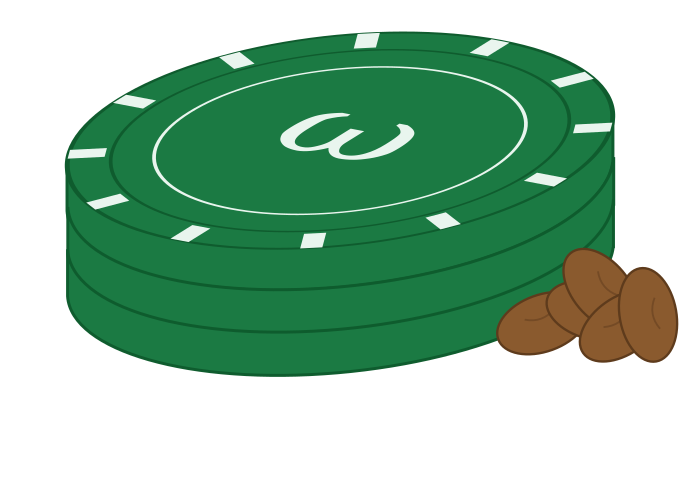
When it's your turn, if you want to move in this heap, you may remove up to three green tokens and up to five beans — any or all. And also, if you remove any green tokens, you may replace them with as many beans as you like, none or five or five billion.
Green tokens and beans are enough to take us almost to !!ω^2!!, but not quite. For !!ω^2!! we need something new. It's a different kind of token, say a square token. When there is a square token in a heap, a player may remove it and replace it with any number of green tokens and beans.
Then we could imagine a cubical token for !!\omega^3!!, which can be removed and replaced with any number of square tokens, green tokens, and beans, and so on, and that gets us almost to !!ω^ω!!.
But there's a simpler way to think about !!ω^ω!!, which I hope to reach in the coming days.
Coming next: Every game of Nim, even with the wildest craziest infinite tokens, must end after a finite number of moves!
And after that:
- Infinite Nim as a coin-moving game
- Coin-moving games without the coins
- Productive programs and well-founded orders
- Shortlex order also orders sequences of numbers
- “Shortlex” isn't actually a single order
[Other articles in category /math/ordinals] permanent link
Fri, 10 Jul 2026
Starting to understand epsilon-zero
This post is going to be about what infinite ordinal numbers are, and about !!{\epsilon_0}!! is in particular. I had a brainwave a while back (18 months now, wow, I have definitely not been blogging enough) and suddenly understood !!{\epsilon_0}!! much better than I did before. I have several related ideas here and I am going to try to write one blog post about each of them, instead of one gigantic blog post about all of them together that I never finish.
I really like the ordinal numbers. For some reason I was repeatedly exposed to the infinite cardinals as a child and, while they are pleasingly mysterious, they're also somewhat uninteresting because they have no internal structure, they are just bignesses. It's super cool that there is more than one possible bigness of an infinite set, of course, but sets can have all sorts of interesting structure, and looking just at the bigness ignores all that.
The ordinals are much more satisfying, and also I feel that they are more like numbers. This post explains how they work and introduces the interesting ordinal !!{\epsilon_0}!!.
What we're doing
The idea behind the ordinals is that we want to define something like the “natural” numbers !!0, 1, 2, \dots!!, where each number has a successor and there is a less-than relation. But we want to do it in the context of elementary set theory, which is simpler. Extremely simple, in fact.
What is set theory?
I don't know how intelligible this article will be if you don't already know, but I am going to try to explain it as briefly as possible. People who already know what !!a\in B!! means can skip to the next section.
In set theory, the only kind of object is a “set”, which is like a featureless bag of things, which are called elements. What kind of things? We don't care, that's not part of the model. The only properties a set has are which things are in the bag.
It doesn't make sense to ask what color a set is or whather it is a citizen of Belgium; sets don't have colors, they aren't citizens of anywhere, and they don't have any other extrinsic properties. The only kind of question you can ask is about a set is:
Is this thing !!a!! in that set !!B!!?
When it is, we write !!a\in B!!, and when it isn't we write !!a\notin B!!.
When a set contains the things !!p, q, !! and !!r!!, and nothing else, we write it as
$$ \{ p, q, r\} $$
so for example !!\text{carrot}\in\{\text{fish}, \text{dog}, \text{carrot}\}!! but !!\text{raincoat}\notin\{\text{fish}, \text{dog}, \text{carrot}\}!!
There is one special set called the “empty set” that has nothing in it at all; it's written !!\{\}!!.
The one other piece of set theory you need to know for this article is that if you have two or more sets, you can combine them into a single set that contains everything that the original sets did. This is called the union of the sets. When combining two sets !!a!! and !!b!!, we write !!a\cup b!! for their union. For example:
$$ \{\text{tea}, \text{coffee}\} \cup \{\text{mango}, \text{octopus}\} = \{ \text{tea}, \text{coffee}, \text{mango}, \text{octopus} \} $$
There is a lot more than that to set theory but that is the basic idea and I think it's enough to get pretty far in this article.
To define numbers in the context of elementary set theory means that we want to find sets that we can interpret as numbers, and a way to interpret arithmetic and such as being operations on these sets. We want to show that those sets can be made to behave the way we expect numbers to behave, and that we can prove that the arithmetic operations have the properties that we expect numbers to have. For numbers, it's true that !!1+1=2!!, and we want to be sure that, whatever we decide that !!+!! means for sets, and whatever sets we've chosen to stand in for !!1!! and !!2!!, we should still have !!1+1=2!!.
Understanding when we can model a complicated system in terms of a simpler one, and how to do that, is one of the main concerns of mathematics. Set theory is just about the simplest system there is, so mathematics spends a lot of time trying to interpret various complicated systems in terms of set theory.
Less-than
Numbers have a less-than relation !!\lt !!, and elementary set theory has only one relation, !!\in!!, so it makes sense to try to use that for less-than, and see if it works. We’ll say that if !!a!! and !!b!! are sets that represent numbers, then !!a\lt b!! means the same as !!a\in b!!.
We want !!\lt !! to be transitive. That is if !!a\lt b!! and !!b\lt c!! then we should also have !!a\lt c!!.
If we're taking !!\lt!! to be synonymous with !!\in!!, then this means that if !!a,b,!! and !!c!! are sets that represent numbers, and if !!a\in b!! and !!b\in c!!, then we should also have !!a\in c!!. This is kind of a weird situation. It means that !!c!! is not a set of fish or carrots, it means that !!c!! is a set of sets. And it means any element of any of !!c!!’s sets is also an element of !!c!! itself. When this happens we say that the set !!c!! is transitive, using the word “transitive” analogously to the way we do what we say that !!\lt!! is transitive.
Transitivity puts fairly strict constraints on what a set can be like. There are lots of sets, but relatively few of them are transitive. Here are some examples of transitive sets, and the numbers they represent:
$$ \begin{align*} 0 &= \{\}\\ 1&=\{0\} \\ \end{align*} $$
Since we are using !!0!! here as just another way to write the empty set !!\{\}!!, we could have written !!1=\{\{\}\}!! instead of !!1=\{0\}!!. They mean exactly the same. But I feel that the nested curly braces quickly get confusing and don't really contribute to understanding. Still, remember that when we write the symbols !!0, 1!!, and so on, we're not using them in their usual sense of numbers. Rather, we are talking about these particular transitive sets.
The next one is:
$$ \begin{align*} 2 & = \{0, 1\} \\ \end{align*} $$
Since !!0=\{\}!! and !!1=\{\{\}\}!! the !!\{0, 1\}!! is an abbreviation for the set
$$ \{\{\}, \{\{\}\} \}. $$
I hope you can see why I want to avoid the raw curly-brace notation.
Continuing, we have:
$$ \begin{align*} 3 & = \{0, 1, 2\}\\ 4 & = \{0, 1, 2, 3\}\\ \vdots\\ 9 & = \{0, 1, 2, 3, 4, 5, 6, 7, 8\},\\ \vdots\\ 53 &= \{0, 1, 2, \dots, 52\}\\ \vdots \end{align*} $$
And so on.
These sets are all transitive. For example, !!3\in 4!! and !!4\in 9!! and sure enough, !!3 \in 9!! also. This isn’t trivial: Not every set of numbers is transitive. For example !!\{3, 4\}!! is not a transitive set because !!2\in4!! and !!4\in \{3, 4\}!! but !!2\notin \{3, 4\}!!.
We'll say that an ordinal number is a set that is transitive, and whose elements are all also transitive sets, and the elements of those are transitive sets, and so on all the way down. All the sets in the list above are examples. There are transitive sets that aren't ordinals, but we're not interested in them in this article, because they aren't number-like in the same way.
This identification of numbers as these particular sets does also make !!\in!! behave like the less-than relation in the way we wanted. For example, we have !!1\lt 2!! because !!1\in\{0,1\}!!, but not vice versa, it's not true that !!2\lt 1!! because !!2\notin\{0\}!!.
Technically this definition has a lot to recommend it. It’s extremely simple, which makes it easy to work with, and many natural theorems are easily proved. For example, when dealing with familiar numbers, it’s always false that !!a\lt 0!!, for any !!a!!. We'd like to able to prove the analogous thing for our synthetic sets-as-numbers. If we can’t (or worse, if we can prove the opposite) then our model is missing something important (or worse, it’s just wrong).
Well, by our definition of less-than, !!a\lt 0!! simply means !!a\in\{\}!!, which is false because !!\{\}!! has no elements, and that's the proof that !!a\lt 0!! is false.
Successorship
Another thing we need from numbers is a successor operation: each number should be followed by another, different one, and it should be possible to calculate which one. This has been recognized since the 19th century as the most important organizing principle that the natural numbers have. It’s is one of the few foundational things that almost every mathematician not only accepts but is happy with.
If !!T!! is some transitive set, we should be able to identify another, different transitive set that we can designate as the successor of !!T!!, the number that follows !!T!! in the sequence of numbers. It’s not hard to show that if !!T!! is transitive then so is
$$ T\cup \{T\} $$
See how it works when !!T=2 = \{0,1\}!!: the successor of !!2!! is
$$ 2\cup\{2\} = \{0, 1\}\cup\{2\} = \{0,1,2\} = 3 $$
as we would hope.
Limits
This gets us the numbers, as we wanted, and we could go on from here to explain how !!+!! and !!\times!! work and so on, but today we are going a different direction. It turns out that if we add one more ingredient we get a lot more than just familiar numbers. There’s one other way of making an ordinal number out of smaller ordinal numbers. If !!O_1, O_2, O_3, \dots!! is any family of ordinals, then their union, the set that contains everything that is in any of them, is an ordinal also.
When the family has a largest element !!O_{\rm max}!!, (typically because it’s a finite family) then the union is not anything new, it’s just !!O_{\rm max}!! again. For example !!1\cup 3\cup 53 = 53!!. But if the family of ordinals has no largest element, we do get something new. In particular, the union
$$ \omega = 0\cup 1\cup 2\cup\dots $$
is an ordinal number.
By constructing the numbers as transitive sets, we got what we wanted: the finite ordinals behave just like numbers. But if we also consider infinite ordinals, we get infinite numbers like !!\omega!! that behave, in some ways, like bigger siblings of the numbers. !!\omega!! participates very nicely in less-than comparisons and minimum and maximum operations, and somewhat nicely in addition and multiplication.
!!\omega!! is an ordinal number but not a familiar one. Under our definition of !!\lt!! as a synonym for !!\in!!, every finite number !!n!! is less than !!\omega!!; there's no familiar number that behaves that way. It’s different from finite numbers in another way also: except for !!0!!, each finite number is a successor of some other finite number and so has a predecessor, whereas !!\omega!! is not a successor of anything and has no predecessor. Ordinals like !!\omega!! that are not successors are called limit ordinals.
(I wrote an article a while back about how, when your twelve-year-old asks “what is infinity” you should answer as if they had asked “what is !!\omega!!”. Later I found out that Joel Hamkins recommended the same strategy, and I still stand by it.)
Every ordinal has a successor, and !!\omega!! is an ordinal, so it has one, !!\omega \cup \{\omega\},!! usually written as !!\omega+1!!, which is the next ordinal after !!\omega!!. Then there follow !!\omega + 2, \omega+3,\dots!!, and the union of all of these is the set
$$ \{0, 1, 2, \dots, \omega, \omega+1, \omega+2,\dots\} $$
which is called !!\omega·2!!—still an ordinal.
After these come !!\omega·2+1, \omega·2+2, \ldots!! and then we can take the union again to get !!\omega·3,!! and then !! \omega·4!! and so on, and eventually !!\omega^2!!. Then after a long series of things like $$\omega^2·17 + \omega·39+117$$ comes !!\omega^3!!, then !!\omega^4, \omega^5\dots!! including an infinite ordinal for every polynomial involving !!\omega!!, for example
$$ \omega^{83}·7 + \omega^{40} + \omega^3·1963782 + 2 $$
and then the union of all those, which is called !!\omega^\omega!!.
The series continues — it continues forever, we can always find a bigger ordinal number — with things like
$$ \omega^{\omega^{\omega^{53}·3+11}·2+\omega·19+1}·7 + \omega^{\omega^{17}·143+53}·12 + \omega^{99938}·12712781 + \omega^{99936}·12712781 +\omega+ 2 $$
where it’s like a polynomial in !!\omega!!, except that the exponents don’t have to be finite numbers, they can be other super-polynomials in !!\omega!! whose exponents don’t have to be finite. And then, after all of these, the limit of this mind-boggling sequence, is the ordinal called
$$ {\epsilon_0} $$
It’s just gotten too complicated to express with regular mathematical expressions involving !!\omega!!. It transpires that this is the smallest ordinal !!x!! satisfying the property that
$$ x = \omega^x $$
This is the thing I have finally been able to get my head around, a little.
The next article will start to explain how:
- Next: Ordinals as nim-heaps
Then:
- Nim always ends, even with infinite ordinals
- Infinite Nim as a coin-moving game
- Coin-moving games without the coins
- Infinite lists and well-founded orders
- Productive programs and well-founded orders
- Shortlex order also orders sequences of numbers
- “Shortlex” isn't actually a single order
[Other articles in category /math] permanent link