


Fri, 25 Sep 2026
L-systems generate weevils, pizza toppings, and matriarchal lineages
The Fibonacci sequence is so-called because in Western mathematics is
first appears in connection with a problem from Fibonacci's 1202 book
Liber Abaci. Fibonacci asks us to consider a rabbit farm where a
pair of baby rabits grows to adulthood in one month, and an adult pair
of rabbits gives birth to a new pair of babies after a month.
Representing an adult pair with a and a baby pair with b, we could
write this as:
    b → a
    a → ab
Starting with one pair of baby rabbits, and performing the indicated substitutions month by month, we get:
    b
    a
    ab
    aba
    abaab
    abaababa
    abaababaabaab
    abaababaabaababaababa
    abaababaabaababaababaabaababaabaab
    abaababaabaababaababaabaababaabaababaababaabaababaababa
    …
The total number of symbols (and pairs of rabbits) each month gives us
the Fibonacci sequence, as does the total number of as, or the total
number of bs, in each line.
A structure like this one, in which there are symbols, in this case
a and b, that are repeatedly replaced with strings of symbols, is
called an “L-system”, and this L-system in particular is the “Fibonacci L-system”.
Yesterday I happened to mention Zyzzyva, which is a genus of weevils that I can only assume was named by a biologist who wanted to be last in the dictionary. When I see a pattern like this I instantly think of the Fibonacci L-system. We can use the Fibonacci L-system to generate a sequence of increasingly long weevil names:
    Yva
    Zva
    Zyva
    Zyzva
    Zyzzyva
    Zyzzyzyzva
    Zyzzyzyzzyzzyva
    Zyzzyzyzzyzzyzyzzyzyzva
    Zyzzyzyzzyzzyzyzzyzyzzyzzyzyzzyzzyva
    Zyzzyzyzzyzzyzyzzyzyzzyzzyzyzzyzzyzyzzyzyzzyzzyzyzzyzyzva
Or pizza toppings:
    eroni
    proni
    peroni
    peproni
    pepperoni
    peppepeproni
    peppepeppepperoni
    peppepeppeppepeppepeproni
    peppepeppeppepeppepeppeppepeppepperoni
    peppepeppeppepeppepeppeppepeppeppepeppepeppeppepeppepeproni
Or family matriarchs:
    Grandma
    Grandmam
    Grandmamma
    Grandmammamam
    Grandmammamammamma
    Grandmammamammammamammamam
    Grandmammamammammamammamammammamammamma
    Grandmammamammammamammamammammamammammamammamammammamammamam
I had to cheat a little here because there's an a in the middle that
I didn't substitute. If we don't skip that we get the unpronounceable
“Grmammandmammamammamma”.
A quick computer search suggests several other variations, including both “mammaries” and “titties”, but to prevent this article from devolving into juvenile sniggering, I'm going to cut the scroll here.
Amazingly, there was a previous article on a closely related topic.

[Other articles in category /misc] permanent link
Thu, 24 Sep 2026
The road to epsilon-zero: “Shortlex” isn't actually a single order
Previously:
- Ordinal numbers and basic set theory
- Ordinals as nim-heaps
- Nim always ends, even with infinite ordinals
- Infinite Nim as a coin-moving game
- Coin-moving games with no coins
- Productive programs and well-founded orders
- Shortlex order also orders sequences of numbers
Something tricky happened a couple of articles ago that I wish now I'd explained more carefully. The recent articles talk about “shortlex order”. But “shortlex order” isn't really just one order. It's actually a method for turning one order into another, fancier one.
The definition I gave said:
The rule to compare two strings in shortlex order is:
- If the strings are different lengths, the shorter one comes first.
- If they're the same length, compare them lexicographically.
But there's something hiding in that “lexicographically”. To compare strings lexicographically, you have to compare them character-by-character, and that means you already have to have some idea of the order of the characters themselves. If we don't notice that “sort these into lexicographic order” is ambigous, it's only because a particular standard ordering of the characters is implicit.
But lexicographic and shortlex orderings aren't restricted to strings of characters. They can be used to extend an ordering on any kind of thing to an ordering on sequences of that-kind-of-thing. If the things are characters, they extend the ordering of the characters to an ordering on strings, which are sequences of characters. But the things don't have to be characters.
In the previous article we took the ordinary ordering on finite numbers (note, not characters) and used the shortlex constructin to produce an ordering on sequences of finite numbers:
Replace any one sequence of [finite number] coordinates with one that is earlier in shortlex order.
The phrase “in shortlex order” there is implicitly assuming the usual ordering of finite numbers. If we had decided to start with a different ordering of finite numbers, the shortlex extension to sequences would be different.
A of couple of episodes ago we saw an ordering of the positive numbers that put all the odd numbers before all the even numbers. Since that basic ordering puts !!7!! before !!4!!, the shortlex extension of it would put !!⟨1, 3, 7⟩!! before !!⟨1, 3, 4⟩!!. And because the basic ordering also put !!33333!! before !!4!! the shortlex extension would put !!⟨1, 33333, 7⟩!! before !!⟨1, 4, 7⟩!!.
Digression
For wacky fun, put the list of words in the dictionary into a lexicographic order that is extended from a different alphabetical order than the usual one!
For example, suppose the alphabet was in the order QWERTY UIOP ASDF
GHJKL ZXCV BNM. The dictionary would start with “queer”, then all the
other QU words up through “quandaries”, finish out the Q section
with a few non-Qu words like “Qantas”, and then continue with the W
words. The last word in the dictionary wouldn't be “zyzzyva”, it
would be “mnemonics”.
Is your kid having trouble learning to alphabetize? Try alphabetizing
this random list into QWERTY order to help yourself feel
sympathetic:
criteria dapple duskiest flapjack gnawing immerses irk puppet surveyor sweetens
Remember, ‘c’ is no longer the third letter of the alphabet, it's now 22nd.
Here they are in QWERTY order instead:
irk immerses puppet sweetens surveyor duskiest dapple flapjack gnawing criteria
Shortlex isn't an order, it's a method for elaborating a simpler order
Say we have some set of things, !!S!! and an order relation on !!S!!, which we'll call !!\prec!!.
We use the symbol “!!\prec!!” rather than “!!\lt!!” to emphasize that this is not necessarily the usual !!\lt!! ordering. We still write !!a\prec b!! to mean that !!a!! comes before !!b!! in whatever order !!\prec!! represents, and analogously we can write !!b \succ a!! means the same: !!b!! comes after !!a!!.
The notation !!S^\ast!! means the set of all finite sequences of elements of !!S!!. For example, when !!S!! is a character set, !!S^\ast!! is the set of strings over that character set. Elements of !!S!! are not at all the same kind of things as elements of !!S^\ast!!. Elements of !!S!! are something-or-others, maybe melons or something — let's say melons, melons are fun — and !!m_1\prec m_2!! if melon !!m_2!! is rounder than melon !!m_1!!. Elements of !!S^\ast!! are sequences of melons.
If !!a!! and !!b!! are two sequences, you can't sensibly ask whether !!a\prec b!! or !!b\prec a!!, since it doesn't make to say that one sequence is rounder than another. !!\prec!! is meaningful for comparing melons, not sequences.
We can't use !!\prec!! to order elements of !!S^\ast!!. But we can lexicographicize !!\prec!! to make a new ordering that makes sense for !!S^\ast!!. To lexicographically compare two elements of !!S^\ast!!, that's two finite sequences of elements of !!S!!, whatever they are, do this:
- Compare the corresponding elements of each sequence, using !!\prec!!, starting with the first elements
- If two sequence elements are different at some posision, the sequence with the !!\prec!!-earlier element comes earlier
- If the two elements are the same, move on to the next corresponding elements and continue similarly.
- If one sequence ends before the other, then that one comes earlier.
If both end at the same time, the two sequences were exactly the same, so neither comes earlier.
This turns !!\prec!! into a lexicographic elaboration of !!\prec!! that makes it work on sequences. This is the same transformation that turns an ordering on characters into the derived ordering for strings.
We can turn !!\prec!! into an ordering for sequences in another way, the shortlex way, producing an order I'll write as !!\prec^\ast!!:
- If the sequences are different lengths, the shorter one comes first.
- If they're the same length, compare them lexicographically as above.
This is the same transformation that turns the regular ordering on digits (!!0\lt 1\dots\lt 9!!) into the derived ordering for ordinary base-10 numerals.
I thought we'd get to !!\epsilon_0!! today, but it seems not. Here's a preview of the next article, though: We're not going to stop with !!\prec^\ast!!, we're going to go on to !!\left(\prec^\ast\right)^\ast!! and !!\left(\left(\prec^\ast\right)^\ast\right)^\ast!!.
[Other articles in category /math/ordinals] permanent link
Wed, 23 Sep 2026
Noting another house repair chore victory
Yesterday I reported about how much I despise home repair, how I feel I'm really bad at it, how it sometimes goes terribly wrong for me, and how my work diary had demonstrated that a seeming failure was catually a glorious success.
I included this picture of our (formerly!) leaky laundry tub, and it reminded me of something else.
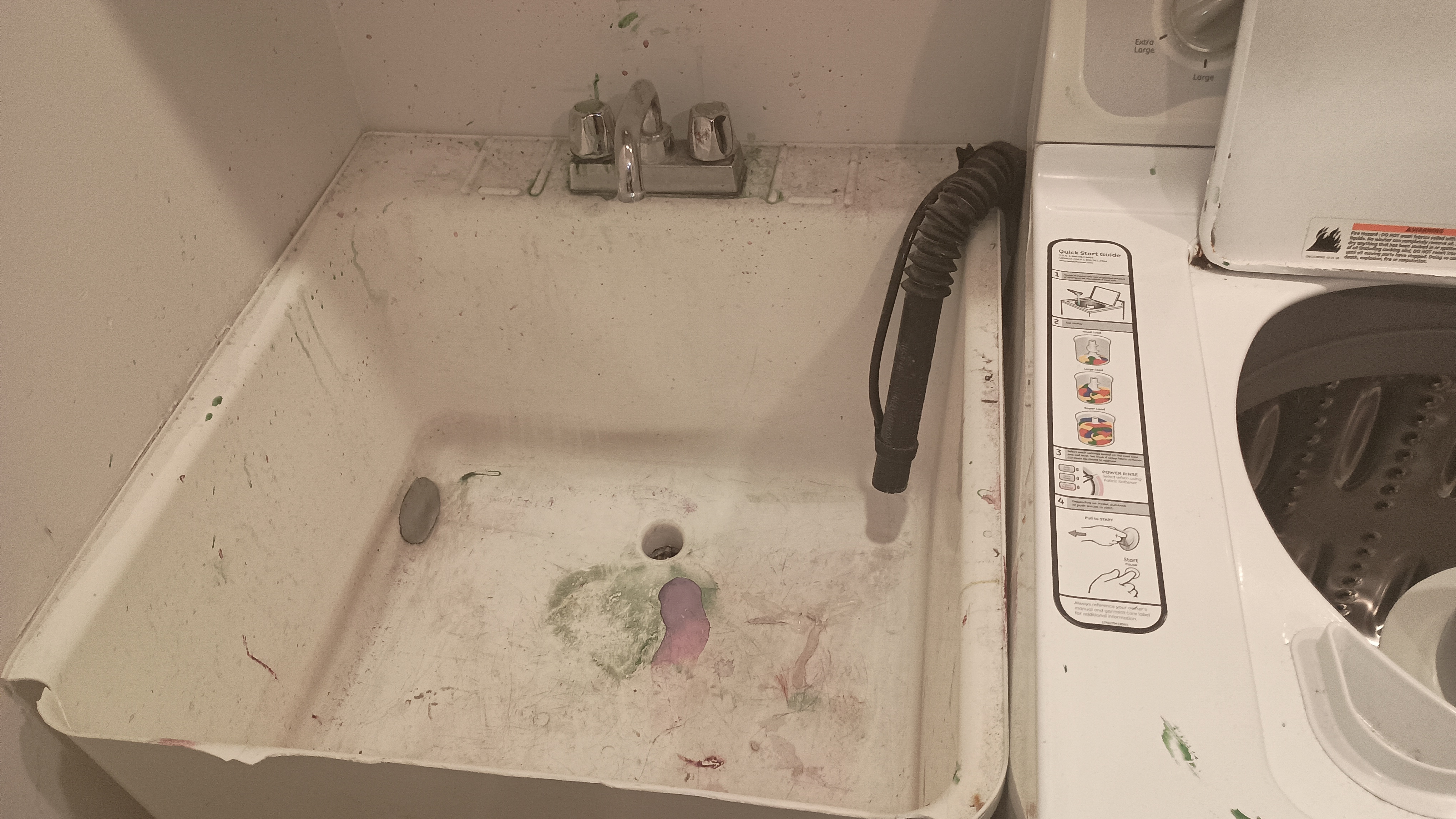
When we first moved into the house, more than four years ago now, that black outflow hose was unsecured. If you weren't careful — and sometimes even if you were — it would thrash around while the washer was emptying, and sometimes spray water everywhere.
In the first week or two after we moved in, there was a long list of minor problems like that. I found some store online that was selling a fix for the thrashing hose. The fix, which you can see in the picture, is a stiff but flexible rod with a collar at each end. You affix the collars around the top and bottom ends of the hose, then bend the flexible rod to force the hose to point in the direction you want. Then the hose can't thrash.
I observed a while back that the worst projects are also the ones that are easiest to remember. These are the ones that drag on for months, requiring endless adjustments, different approaches, and a lot of thought and toil. Or they're the ones that fail completely leaving some unfinished damage that reminds me every day that what I did didn't work.
Here's an example in the other direction. I didn't know how to solve this problem, but I found a solution, I executed it, and because the solution has worked flawlessly for more than four years I completely forgot about it until today when I was looking at this photo.
The work diary can help with this sort of thing. If I had a rollup page for laundry room issues I would be able to open it and see a list of all the things I had gotten right over the years, instead of forgetting them and only remembering the stuff that went wrong.
Addendum
Another example that occurs to me: in our house it's my job to unclog toilets. How many times over the years has a toilet clogged and I unfussily unclogged it with the plunger? Too many to count. And there have been other occasions when the plunger didn't work, so I would shrug, and go downstairs to get the toilet auger. I don't remember these many episodes because to me they were no big deal.
I should try to remember that no matter how incompetent I feel in general, just owning a toilet auger puts me way ahead of a lot of other people.
[Other articles in category /brain] permanent link
Tue, 22 Sep 2026[ Content warning: mundane, rambly, neurotic. ]
A couple of years back I wrote a long whiny blog article about putting up some shelves in the bathroom and how miserable it had made me to do it. I said:
When I put up shelves in the bathroom back in May, I was a psychological mess. For every little thing that went wrong — and there were quite a lot — I got all stressed out and wondered why I dared to perform this task. The outcome was good, but I had a lot of stress getting there.
Through the whole thing I felt like I didn't know what I was doing, I didn't know if I was about to make some terrible mistake that would ruin the whole project, and I didn't know if I was about to produce a humiliating disaster that a professional would have to be called in to do over.
This is a lot of bad feeling for a project that, in hindsight, went smoothly and ended in success. I finished timely. The shelves served us well until we moved out eight or nine years later. I don't think that most of the people who came through there thought anything like “gosh, I wonder what incompetent installed these ridiculous shelves?”.
Anyway that is not what I planned to talk about this time.
I loathe home repair
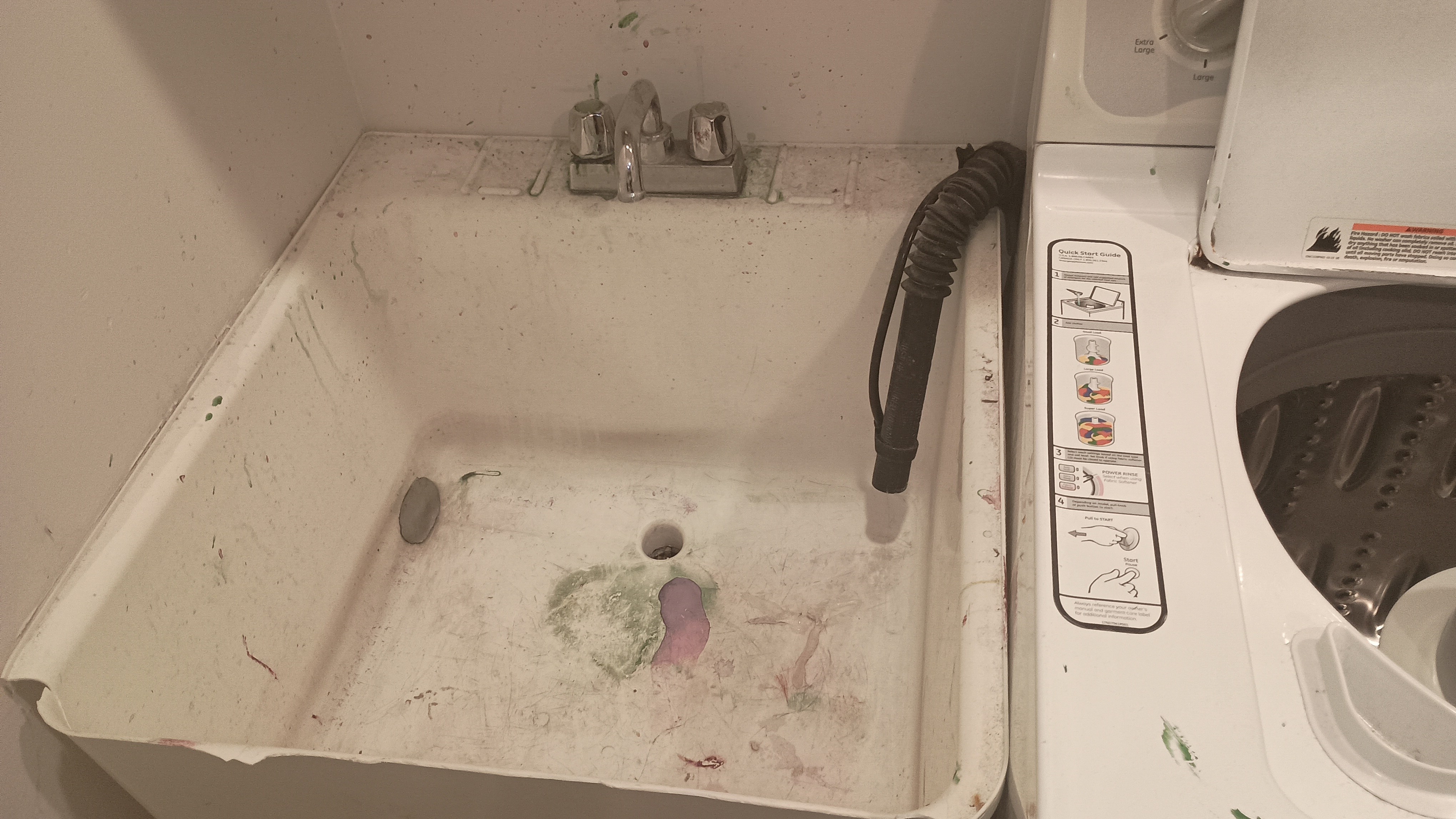
In our laundry room the washer dumps its outflow into a deep plastic sink with a drain, which we call a "tub". A while back the tub developed a big crack in its bottom that was leaked dirty water onto the floor. We put a bucket underneath, but that is just a workaround, not an actual solution.
I thought with displeasure of the two unpalatable choices for replacing the tub with a new one. I could pay a plumber to do it, and it would probably be done competently, but would cost a lot of money. Or I could attempt to do it myself, and it might be done competently, and it might cost much less money… or I might be taking the first step on the road to Hell.
If I were to attempt it myself, I would not only have to learn how to do the task, and then get it right the first time, I would also have to figure out on the fly how to fix the parts of the task I didn't get right the first time. The worst case here could be very bad, much worse than just “oh well, guess I'll have to call the plumber”. There are a lot of ways it can go very wrong.
I'd have to buy supplies, the right supplies, and if I discovered partway through that I didn't have the right supplies or tools I'd have to stop work and go back to the store for the right ones, interrupting the project. Or maybe the store has closed and we are without laundry service until it reopens.
If I didn't get the task done right the first time, I would need new supplies to try again, and maybe additional supplies to fix the mistake.
I might break something else that wasn't broken to begin with.
I do not find this kind of work fun. I hate it, and the longer it goes on the more I hate it. By trying to replace the tub myself I might be stepping into a tar pit.
This isn't just neurosis. There are projects in my house that I thought would be straightforward that are perpetually unfinished for exactly this sort of reason: I started, and something went wrong that I didn't know how to fix.
In these kinds of jobs there is often some subtask where you have to get two parts together by forcing them, or there is often some subtask where you have to cajole two parts together but forcing them will ruin them. If you mistake the second kind of subtask for the first you have the fun of putting the broken parts in the trash and starting over, or maybe just hurling yourself into the sea.
So instead of replacing the tub, I thought that I could try an easy intervention: I could try to seal the crack with silicone goo. It might not work at all, but it would be quick and easy to try, and it wouldn't make the problem worse than it already was — the tub was already leaking. And I had the silicone in the house already.
I did that and it seemed to work, so with relief I put it out of my mind for a while.
Return of the leak
Time passed and last week I learned that the tub was leaking again. I took a look into the tub and saw that the silicone from last time seemed to be holding okay, but that the crack had gotten bigger.
I was disappointed. I had hoped that the silicone would solve the problem. But it appeared that it hadn't, and the leak was just going to keep coming back. The silicone hadn't worked, except as a short-term workaround, and it seemed I would need to replace the tub anyway.
Probably, I thought, if I knew what I was doing, I would have known that silicone goo is not the right way to fix something like this. Maybe someone who knew the right way would have scoffed and said “Silicone? Pff, don't you know that stuff will start coming off in two weeks?” Or maybe “Pff, that crack is just going to spread.”
But I went and glumly patched the new, bigger crack with more silicone to give me some time to think about what to do to take care of the problem for good.
Work diary to the rescue
And then something magic happened. I went to make a note about it in my work diary.
The work diary is just an attempt to track stuff at home with a ticketing system, similar to how I do when I'm at work. Each task I need to do gets a ticket, which starts out as a mostly blank page. When I work on a task, I make a note in the ticket about what I did, with the date. When a task is done, I mark the ticket closed.
When the tub had first started leaking I had opened a ticket for it. Then whenever there was some new development on the tub, I added a date and a note — there was a cluster of notes from around the time I had been trying the silicone, noting what kind I had used and how long it had taken to cure. Then I had closed the ticket. Now I reopened it.
Why go to the trouble of a ticketing system for chores like this one? There are lots of reasons, and I hope to write more about this in the future. But today's an example is an unusually good one:
When I went to update the ticket with the new status, I saw that my previous attempt to fix the problem…
(the one I thought hadn't worked…)
had been in May 2025.
The silicone patch I had put on had solved the problem for sixteen months. I had had no idea that it had been so long ago.
That changed things completely. I had been thinking:
I put the silicone on, it worked for a while as a stopgap, but it soon failed and I need to come up with a different plan.
Wrong! With the new information, there was a completely different interpretation:
I put the silicone on, it took only twenty minutes, cost next to nothing, and worked for sixteen months.
The patch was not a failed workaround, not a short-term solution while I figured out the real solution. The silicone was the real solution! If all I need to do to keep the tub working is to smear goop on it every sixteen months, I don't need a better solution!
That date recorded in the work diary changed “it didn't work” into “problem solved”.
Addendum 20260923
A followup about the work diary as it relates to other laundry machine issues
[Other articles in category /brain] permanent link
Sat, 12 Sep 2026
George Orwell's essay on the atomic bomb anticipates Nineteen Eighty-Four
Lately I've been reading Orwell's collected work from 1945–1950, which was being deaccessioned from the library. It opens with a short but fascinating essay on “You and the Atom Bomb”, published 19 October 1945. It seems clear that Orwell's thinking about this development led directly to his novel Nineteen Eighty-Four, which was written in late 1948.
Orwell's initial focus is:
The question that is of most urgent interest to all of us, namely: “How difficult are these things to manufacture?”
This is important, he says, because:
Ages in which the dominant weapon is expensive or difficult to make will tend to be ages of despotism, whereas when the dominant weapon is cheap and simple, the common people have a chance. … A complex weapon makes the strong stronger, while a simple weapon — so long as there is no answer to it — gives claws to the weak.
Obviously, the atom bomb is in the first category.
Then we come to the part that is clearly the road to Nineteen Eighty-Four:
We have before us the prospect of two or three monstrous super-states, each possessed of a weapon by which millions of people can be wiped out in a few seconds, dividing the world between them. It has been rather hastily assumed that this means bigger and bloodier wars, and perhaps an actual end to the machine civilisation. But suppose — and really this is the likeliest development — that the surviving great nations make a tacit agreement never to use the atomic bomb against one another? Suppose they only use it, or the threat of it, against people who are unable to retaliate? In that case we are back where we were before, the only difference being that power is concentrated in still fewer hands and that the outlook for subject peoples and oppressed classes is still more hopeless.
By 1945 the three super-states were taking shape. Orwell writes about how in 1941 it had appeared that the Axis powers would win the war (he mentions James Burnham's The Managerial Revolution) so that Germany (not Russia) might control Europe and Asia, while Japan (not China) might control East Asia, but he said this was just a “miscalculation”:
More and more obviously the surface of the earth is being parcelled off into three great empires …. The haggling as to where the frontiers are to be drawn is still going on, and will continue for some years, and the third of the three super-states — East Asia, dominated by China — is still potential rather than actual.
The frozen and oppressive political milieu of Nineteen Eighty-Four is clearly laid out:
Mr H.G. Wells and others have been warning us that man is in danger of destroying himself with his own weapons…. Nevertheless, looking at the world as a whole, the drift for many decades has been not towards anarchy but towards the reimposition of slavery. We may be heading not for general breakdown but for an epoch as horribly stable as the slave empires of antiquity. … The kind of world-view, the kind of beliefs, and the social structure that would probably prevail in a state which was at once unconquerable and in a permanent state of “cold war” with its neighbours.
Nineteen Eighty-Four was published in 1949, and Orwell died the following year after a long battle with tuberculosis. His essay on “You and the Atom Bomb” is available online courtesy of the Orwell Foundation and Orwell's estate.
[Other articles in category /book] permanent link