


Sat, 27 Jun 2026
A while back I related how I had been mocked by an English person for using the word “burglarize”. I ended by saying:
Okay, whatever. Brits have been mocking the American language for centuries now. Let them go ahead. We all know who won that argument.
Since then I've been comforted by that thought. I smile to myself and say “It's ours now, we have you outnumbered.”
But for the last few years this has always been followed by another thought: On that logic, it actually belongs to the Indians. And yes, it probably does and we just haven't noticed yet.
But we will.
[Other articles in category /lang] permanent link
I owe my life to a 1913 road rage incident
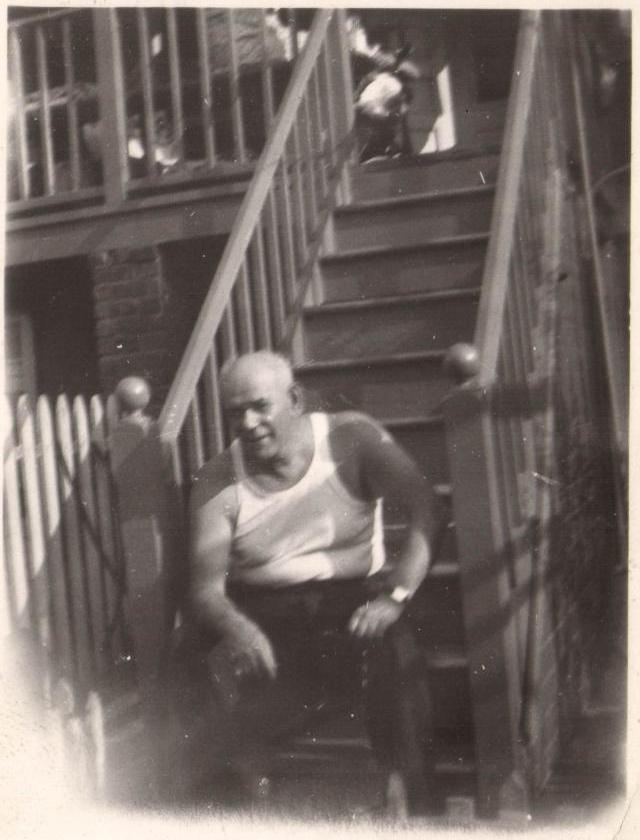
This is my great-grandfather, born Dominusz Andor in Szeged, Hungary in 1886. In the picture he is in Brooklyn, New York, probably sometime in the early 1950's.
By 1911 Andor had moved from Hungary to Vienna and had changed the spelling of his name to “Dominus” to save confusion. He worked as a goldsmith, and owned his own jewelry shop, so he must have been doing OK.
There's a family legend about why Andor left Vienna for the USA, and I was never sure whether I believed it. But thanks to the Wonders of the Internet, I was able to find out the details, which were all over the Viennese papers in the spring of 1913, and were even reported as far away as Budapest.
In 1913, Andor owned a motorcycle with a sidecar. On March 24 he was driving around Vienna with his wife Rosa when the sidecar came detached. Andor stopped to repair it, and a crowd gathered to watch. Some local youths offered to “help”, rocking the motorcycle and honking its horn.
After the sidecar was re-attached, The youths demanded a tip, which Andor refused to pay. But he also asked the boys to push the motorcycle forward. This they did, but they also hit him and Rosa in the back of their heads; Rosa responded by punching one of them in the face. The boys jeered and shouted insults. As Andor started to drive away, some people in the crowd threw rocks.
Andor, frightened or angry, took out his Browning pistol. He later claimed to have fired two warning shots into the air. Whatever he meant to do, one of his shots hit a 22-year-old butcher's assistant in the chest. Fortunately the bullet lodged in the young man's breastbone. The second shot went through the hat brim of a 12-year-old boy without hurting him. Andor fled the scene.
The police caught up with him that evening at his home, having traced the owner records of the motorcycle, whose license plate number had been noted by people in the crowd. He was arrested and, as he was a foreigner, was deemed a flight risk and jailed pending trial.
In May he was tried. His claim of self-defense was rejected, since by the time he had fired his gun he and Rosa were already about twenty paces from the crowd. He was found guilty of assault, mitigated by the circumstances, and sentenced to a week of prison time, which he had already served several times over. However, the butcher's assistant, by then out of the hospital, announced his intention to sue in civil court for lost wages and for pain and suffering.
I haven't yet found the ship manifest that says exactly when Andor arrived in the U.S., but it was no more than four months later. He either fled to avoid the suit, fled to avoid paying the judgement, or, perhaps, just decided he had had enough of Vienna. (I would have been a bit annoyed too, after serving two months of a one-week sentence. Also, his goldsmith shop had been robbed two years before, by thieves who used the shop's own electric drill to break through the back of the safe.)
Rosa and their son Sándor, then four years old, arrived in October 1913 and the family settled in Brooklyn. Andor was naturalized in 1920, and his mother came over in 1921.
Sándor's parents changed his name to the more American-sounding “Samuel”. Samuel remained in Brooklyn until he retired in the early 1970s, by which time he was my paternal grandfather.
It's a good thing for me that the second bullet didn't hit the little boy in the head, or I wouldn't be here to tell you about it.
[Other articles in category /history] permanent link
Tue, 23 Jun 2026Making the rounds last week was this magnificent article on the complications of Arabic typesetting, An interactive introduction to the terrific experience of rendering Arabic typography and its technical debt. The author, Saleh, promises:
The reply took and the closure of the ticket took half an hour or so. The reasons behind it took five hundred years to pile up, and they involve a twice-mutilated vizier, a Qurʾān that vanished for four centuries, a Beirut newspaperman with a deadline, and an Egyptian physician who taught himself font engineering for fun (or that what I imagine about him). Walking through these, ended up to be the most enjoyable couple of weeks in that job, and I want to go through it here too.
And then wow, does it deliver. Don't read my article, go read Saleh's instead, or at least read it first.
Still here? Then a disclaimer: I do not know Arabic, not even all the letters, yet. I tried hard to get the details right in this article, but I expect there are misspellings, misstatements of fact, and so on, for which I apologize in advance.
In one of my favorite parts of his article, Saleh discusses how, because Arabic script is always cursive, it is important how the letters are joined to one another. Modern Latin script has only a few ligatures, and omitting them is barely noticeable:


But in Arabic, the ligatures are important. The text looks grossly wrong without the correct ligatures.
Early font engines couldn't render Arabic ligatures properly, and on-screen Arabic text always came out looking ridiculous, with the letters separate like Latin script letters, which is completely wrong for Arabic. Saleh gives this example, which says “hello, world, this is Arabic text”. It should look like this:
مرحبا بالعالم، هذا نص عربي
But early font renderers rendered it like this:
مرحبا بالعالم، هذا نص عربي
The crappy rendering was unfortunate, and only barely tolerable, just barely better than nothing. Even if you don't read Arabic (I don't) you can see the differences. Notice, for example how the elegant and symmetric cluster لعا is mangled to لعا. Or look at just the first (rightmost) letter. It is the Arabic letter ‘m’, called mīm. It is supposed to connect with the letter next to it, and not to have that hanging tail, which only appears when mīm is written by itself, or at the end of a word.
For the supremely important phrase
بِسْمِ ٱللهِ ٱلرَّحْمَٰنِ ٱلرَّحِيْمِ
the crappy rendering was not tolerable. This phrase is “bismillah al-raḥman al-raḥim”. It means “in the name of God, the gracious, the merciful”, and it appears at the start of each of the 114 surahs (chapters) of the Qur'an (except the ninth for some reason). There is a centuries-long tradition of calligraphic expression of this phrase, in the most perfect possible ways.

“Khalili Collection Islamic Art cal 0154", Ottoman Turkish, 19th century. Public domain, via Wikimedia Commons.

It would be blasphemous to render this phrase, called the “basmala”, this crucial expression of honor for God, as a jumble of letters. Imagine if Exodus 20 had had God introducing the Ten Commandments by saying

The incredible solution to this one problem was the inclusion in
Unicode of a special codepoint U+FDFD ARABIC LIGATURE BISMILLAH AR-RAHMAN AR-RAHEEM.
As a single codepoint, the basmala could be assigned a single glyph, and the
single glyph could be designed correctly, so as not to look like
trash.
Here it is. Remember, this is a single character:
In Firefox, with my fonts, the glyph renders like this, long and narrow:

but on my Android phone there is a very different glyph. Here it is, highly magnified:

What's going on here? It's fun to find out.
The basmala actually has four words (“bismillah” is a contraction):
- Bismi (بسم, “in the name of”)
- Allah (اللّٰه, “God”)
- al-raḥman (الرحمن, “the gracious”)
- al-raḥim (الرحيم, “the merciful”)
(At some point I should slip in that when the word “al-” (which means “the”) appears before an /r/ sound, its /l/ is assimilated, so that it is pronounced like /ar-/. This is analogous to what happens when the English prefix “in-” is attached to a word like “relevant”. “Inrelevant” is tricky to say, so the /n/ is assimilated and the word is spelled and pronounced “irrelevant”.)
Here are the four words picked out in different colors. To a person literate in Arabic, I suppose this is obvious, but I found it a bit challenging.

“Allah” الله is at the top. (I'm told this is traditional.) I've colored it green because green is said to have been Muhammad's favorite color.
The two marks above it, the W-shaped mark and the vertical stroke above it, are diacritic marks (one called a shaddah and other other indicating the vowel). I'm not sure how optional they are, but in an earlier draft of this article I tried to explain them in detail and got bogged down in a multi-paragraph digression about the morphology of the word “Allah”, so I'm just going to move on without commenting on them further.
Below “Allah”, in red, is “bismi”. In Arabic this has three letters, /b/ + /s/ + /m/, since the vowels are omitted. At the right we have بس which is /b/ + /s/; the letters are named bā' and sīn. Then there's a horizontal stroke, called a kashida, under “Allah”; this is just for layout, analogous to white space, and is not pronounced. Finally the م (/m/, called mīm) over on the left. Mīm م has a long tail when it appears at the end of a word, as here, and the designer has decided to attach the tail to the ن (/n/, nūn) at the end of al-raḥman. You can see the same final م mīm and its tail at the end of the purple word al-raḥim, and in the middle of the blue word al-raḥman without the tail.
(Khaled Hosny, designer of the widely used Amiri font, told me that the design of the Android basmala glyph is very bad. One of his criticisms was “the bizarre fusion of the letters” and I suppose the attachment of the م and the ن is one of the things he had in mind. He also objected to the insertion of “Allah” into the middle of “bismi”.)
The third word, in blue, is al-raḥman الرحمن which as you can see starts with the same letters as al-raḥim الرحيم. You can also see the same first two of those letters at the start of “Allah” الله. As I mentioned before, “al-” means “the”, so you see it at the beginning of many Arabic words. It also survives in many English words that are descended from Arabic, such as alcohol, alcove, algebra, algorithms, and alchemy.
(Not, however, “alligator”, where the “al-” is the Spanish word for “the”.)
The /r/ sound in al-raḥman and al-raḥim is made by the letter rā', which is written as the down-hanging hook to the left of the ال, as here: الر. The designer has connected the hook of the blue rā' with the upper part of a purple letter called ḥā'. (I suppose Hosny also dislikes this.) When written by itself ḥā looks like this: ح but when it's in the middle of a word it loses its fancy tail. The ḥā is of course the common ḥ in both al-raḥman and al-raḥim.
Let's see, what else? The only letter I haven't mentioned is the fifth letter in al-raḥim الرحيم, just before the mīm and its tail, called yā'. When by itself, it is written ي, but in the middle of a word like al-raḥim, it is the upward-pointing spike with two dots below.
Arabic writing is very beautiful, isn't it? Last time I tried to learn the alphabet I got stuck because I was trying to learn the sounds at the same time, and Arabic sounds are very different from English sounds. Arabic has three sounds that resemble English /h/. One is very soft, one is very rough, and one is in between. Ḥā' ح is the in-between one, represented in English as ‘ḥ’. The soft one, hā', is the last letter in الله Allah. Arabic also has a glottal stop, which is a sound rarely used in English, but I have some practice saying it because it's the apostrophe in “Hawai'i”.
Wikimedia Commons has a gallery of basmalas, and web search produces thousands more. I am looking forward to understanding more of them.
[Other articles in category /lang] permanent link
Thu, 18 Jun 2026
My 1992 view of the problems of computer programming in 1992
While cleaning out my office today, I found this, which I wrote in 1992:
In the middle 1970's, the IBM corporation did (and perhaps still does) most of their in-house programming in a computer language called FORTRAN. They had a pretty good FORTRAN compiler, called the FORTRAN G compiler. It was fast at translating FORTRAN into machine instructions, and the machine instructions it produced implemented the desired behavior fairly efficiently. Nevertheless, IBM decided to write a new compiler.
This was very daring in the middle 1970's, because compilers were quite complicated programs, and are difficult to write, and it was surprising that IBM was willing to invest the vast resources that a new compiler would require when an adequate compiler was still available. IBM spent millions of dollars and hundreds of programmer-years, and produced the FORTRAN H compiler, which was fast, efficient, and full of nice features. It was an excellent compiler and is still the one that they use.
Here is the first punch line: Compiler programs are no longer difficult to write. The past fifteen years have seen an enormous increase in our understanding of compiler technology and how to write a compiler. Compilers are so easy to write now that third-year undergraduate computer science majors are expected to be able to turn out passable compilers in one semester.
Now a question: Since we're obviously thousands of times better at producing compilers than we were fifteen years ago, so much so that a single undergraduate can write a passable one in four months, why hasn't IBM invested millions of dollars and hundreds of programmer-years to produce a super FORTRAN I compiler that's thousands of times better than the FORTRAN H compiler?
The answer is that compiler program quality is no longer the limiting factor on our ability to write computer programs. The problems that programmers face no longer have to do with how good the compiler is. Instead, they are problems of method and language. We don't really know how to program yet, or how to manage our programs. We don't really know what we want to say or how to say it. We don't have good computer languages for expressing what we want to computer to do. We don't know how to think about programming. In short, the reason IBM doesn't bother with a super FORTRAN I compiler, is that no matter how good it was, it would still be FORTRAN.
Computer programming is still a black art. It's less than fifty years old, and nobody is very good at it yet. We can make better tools than we know how to use.
[Other articles in category /prog] permanent link
Wed, 17 Jun 2026
Egyptian fraction multiplication
(Very much previously: Egyptian Fractions)
Back in March, I had been reading On the Egyptian method of decomposing !!2/n!! into unit fractions by Abdulrahman A. Abdulaziz, and I reported that:
There is some indication that Ahmes preferred fractions with even denominators, because they are easier to double, and the usual Egyptian method of multiplication required repeated doubling.
Although I had long ago written an article about why the Rhind mathematical papyrus (RMP) has a table of Egyptian fraction expansions of !!\frac23, \frac25, \frac27\ldots!! but no similar table for any other numerator. I had proposed a very reasonable algorithm for how the table of !!\frac2n!! would give you the ability to compute !!\frac mn!! for any !!n!!, but for some reason I never connected this in my head with how the Egyptians actually did multiplication. The Egyptian multiplication algorithm makes my original surmise very plausible, but a little bit inside-out.
Also, this blog has somehow never discussed the ancient Egyptian method of multiplication, which reduces multiplication to addition without a need for multiplication tables. You don't have to remember complicated facts like !!7×8=56!!, only simple facts like !!7+7=14!!.
Egyptian multiplication
Let's say we'd like to multiply !!364!! by !!41!!. First let's observe that it's quite easy to double a number like !!364!!, significantly easier than to multiply it by anything else. First, !!4+4=8!!, so write down an !!8!! under the !!4!!:
$$ \begin{array}{} 3 & 6 & 4 \\ & & {\bf 8} \end{array} $$ Now !!6+6=12!! so write down a !!2!! under the !!7!! and note a carry in the next column. Or just remember it until the next step — when doubling, the carry is never bigger than !!1!!, so we don't have to remember how much it is, just that there is one:
$$ \begin{array}{} 3{\bf {}^\bullet} & 6 & 4 \\ & {\bf 2} & 8 \end{array} $$
The little mark by the !!3!! means that we are remembering there was a carry from the previous column.
Now !!3+3!! plus the carry is !!7!!, so write the !!7!! under the !!3!!:
$$ \begin{array}{} 3^\bullet & 6 & 4 \\ {\bf 7} & 2 & 8 \end{array} $$
And yes, !!364+364=728!!, quick and easy. Between each step and the next we only need to remember one thing: is there a carry? And someone can do the whole thing with minimal training, knowing only that !!1+1=2, 2+2=4, 3+3=6,\dots, 9+9=18!!.
Let's double again:
$$ \begin{array}{} 7 & 2{\bf {}^\bullet} & 8 \\ & & {\bf 6} \\[10pt] 7 & 2^\bullet & 8 \\ & {\bf 5 } & 6 \\[10pt] 7 & 2^\bullet & 8 \\ {\bf 14} & 5 & 6 \end{array} $$
When the Egyptians wanted to multiply !!364×41!!, they would do a series of these doublings, and label each one (perhaps just mentally) with the corresponding power of 2:
$$ \begin{array}{rr} 1 & 364 \\ 2 & 728 \\ 4 & 1456 \\ 8 & 2912 \\ 16 & 5824 \\ 32 & 11648 \\ \end{array} $$
Then they'd find the numbers in the left-hand column that added to 41, and mark them. This is easy to do, using the greedy method: !!32 < 41!!, so mark the !!32!!, then subtract !!41-32=9!! and proceed up to the next line. !!16\not\lt 9!!, so don't mark the !!16!!, but do mark the !!8!!, and so on:
$$ \begin{array}{rrr} 1 & 364 & ✅ \\ 2 & 728 & \\ 4 & 1456 & \\ 8 & 2912 & ✅ \\ 16 & 5824 & \\ 32 & 11648 & ✅ \\ \end{array} $$
Now just add up the middle column of numbers, but ignore the lines with no check marks:
$$ \begin{array}{rrr} 1 & 364 & ✅ \\ 8 & 2912 & ✅ \\ 32 & 11648 & ✅ \\ \hline & {\bf 14924} & \end{array} $$
And that's the answer, !!364 \times 41 = 14924!!. Isn't that cute?
The algorithm is really quite practical. It is often known as the Russian Peasant algorithm, apparently because it was also used by actual Russian peasants.
Once again, with fractions
Now fractions. Say we want to multiply !!4+\frac{1}{35}!! by !!29!!. The !!4!! we already know how to do and it is easy enough, we just do it like above, doubling !!4!! repeatedly and adding the correct doubles. Or if we're even a little clever we realize we can do it by doubling !!29!! twice, which is quicker.
But Egyptian notation for fractions was terrible. They had a notation for !!\frac1{35}!!, and a special notation for !!\frac 23!!, but no general quotient operation like the fraction bar. Instead they wrote fractions as sums of “unit fractions” with numerator !!1!!, and they had tables like the one in the Rhind Mathematical Papyrus, for converting non-unit fractions to sums of unit fractions, for example $$\frac2{35} = \frac1{30} + \frac1{42}.$$
!!\def\uf#1.{\frac1{#1}}\def\u#1.{\uf#1.}!!
So now we want to multiply !!19\times \frac1{35}!!. Per the algorithm we need to double !!\frac1{35}!! four times until we get !!\uf35. \times 16!!. For the first doubling we go to the table for !!\frac2{35}!!:
$$ \begin{array}{} 1 & \uf35. \\ 2 & \uf30. + \uf42. \\ \end{array} $$
For the next doubling, we don't have to go to the table, because the double of !!\uf30.!! is just !!\uf15.!! and the double of !!\uf42.!! is !!\uf21.!!. That's why the table prefers expansions with even denominators.
$$ \begin{array}{} 1 & \uf35. \\ 2 & \uf30. + \uf42. \\ 4 & \uf15. + \uf21. \\ \end{array} $$
For the third doubling we do go back to the table to find !!\frac2{15}!! and !!\frac2{21}!!:
$$ \begin{array}{} 1 & \uf35. \\ 2 & \uf30. + \uf42. \\ 4 & \uf15. + \uf21. \\ 8 & \uf10. + \uf30. + \uf14. + \uf42. \\ \end{array} $$
Since the denominators in the fourth row are all even, we don't need to consult the table to write the fifth row:
$$ \begin{array}{} 1 & \uf35. \\ 2 & \uf30. + \uf42. \\ 4 & \uf15. + \uf21. \\ 8 & \uf10. + \uf30. + \uf14. + \uf42. \\ 16 & \uf5. + \uf15. + \uf7. + \uf21. \\ \end{array} $$
Now we wanted !!29\times\uf35.!!, so add rows !!16, 8,4,!! and !!1!! because !!16+8+4+1=29!!. We get this:
$$ \begin{array}{rl} \frac{29}{35} = & \u35. \\ & + \color{darkgreen}{\u15.} + \color{purple}{\u21.} \\ & + \u10. + \u30. + \u14. + \u42. \\ & + \uf5. + \color{darkgreen}{\uf15.} + \uf7. + \color{purple}{\uf21.} \\ \end{array} $$
Oh no…
There are duplicates of !!\color{darkgreen}{\u15.}!! and !!\color{purple}{\u21.}!! and that's not allowed, so we use the !!\frac2n!! table to replace the !!\color{darkgreen}{\u15.+\u15.}!! with !!\u10.+\u30.!! and the !!\color{purple}{\u21.+\u21.}!! with !!\u14.+\u42.!!:
$$ \begin{array}{rl} \frac{29}{35} = & \u35. \\ & + \u10. + \u30. + \u14. + \u42. \\ & + \u5. + \u7. \\ & + \u10. + \u30. \\ & + \u14. + \u42. \end{array} $$
Now we have duplicate !!\u10., \u14., \u30.!! and !!\u42.!!. Fortunately all the denominators are even:
$$ \begin{array}{rl} \frac{29}{35} = & \u35. \\ & + \u5. + \u7. \\ & + \u5. + \u7. + \u15. + \u21. \end{array} $$
Now we go again to the table to eliminate the two !!\u5.!!'s and !!\u7.!!'s:
$$ \begin{array}{rl} \frac{29}{35} = & \u35. \\ & + \u3. + \u15. + \\ & + \u4. + \u28. + \\ & + \u15. + \u21. \end{array} $$
Once again we have two !!\u15.!!'s:
$$ \begin{array}{rl} \frac{29}{35} = & \u35. \\ & + \u3. \\ & + \u4. + \u28. + \\ & + \u21. \\ & + \u10. + \u30. \end{array} $$
and we are finally done, having discovered that !!\frac{29}{35} = \u3. + \u4. + \u10. + \u21. + \u28. + \u30.!!. Wow.
A slightly cleverer method would be to observe that !!29\times\u35. = \u35. + 28\times\u35. !!, and that !!28\times\u35. !! is simply !! 4\times \u5.!!. I imagine that a competent Egyptian scribe would have noticed this.
Did they really do this?
Wikipedia hints that perhaps the Egyptian didn't actually do go through all of this trouble, that perhaps they computed !!\frac{29}{35}!! first the way we did, as a vulgar fraction, and then only converted to the awful sum-of-unit-fractions notation when they needed to record the final answer.
This would have been analogous to how for hundreds of years Europeans would convert awful Roman numerals into an arrangement of counting board tokens (an abacus, essentially), do the calculation on the counting board, and then convert back to awful Roman numerals to record the answer.
While preparing this article I wondered: how can we even be sure that the algorithm will terminate? It's not clear to me. There was that point where we got rid of a !!\frac2{15}!! and then it came back and we had to get rid of it again.
I had Claude implement the algorithm, using the actual RMP !!\frac2n!! table, and run it for every product up to !!100\times \u101.!! to see if it would get stuck in any loops. It didn't.
It's possible that it would have looped if the !!\frac2n!! table I used had been a little different, and it would be very interesting to learn if the table itself had been somehow constructed so as to prevent the algorithm from looping. But I think it's more likely that it terminates for any reasonable !!\frac2n!! table, because the algorithm has some invariant that always decreases — one which I'm not yet clever enough to see.
I mentioned in the previous article:
The Egyptians, like everyone, often had to multiply by 10.
Most of the really big denominators in the !!\frac2n!! table are multiples of !!10!!. For example it has !!\frac2{47} = \u30. + \u141. + \u470.!! and if you're multiplying by !!2!! or even by !!10!!, only the middle part of this is any trouble. I wouldn't want to multiply !!10\times\u141.!! by the algorithm above, though — the !!\frac2n!! table doesn't even go that high. But maybe they would have done something like:
$$ \begin{array}{rl} 10\times \u141. & = 9\cdot\u141. + \u141. \\ & = 9\left(\u3. \times \u47.\right) + \u141. \\ & = \frac2{47} + \u47. + \u141. \end{array} $$
which doesn't seem too awful.
This whole thing raises a big question for me. To have useful numbers, you need three things:
- Addition
- Multiplication
- Comparison
People often forget #3, but it is crucial, because in the real world you are using the numbers to answer questions like “do we have enough bread to feed 119 laborers for 21 days?” or “will the bridge hold if I drive two loaded ox-carts across it” or similar questions that involve comparisons.
Say we're trying to figure out how to divide nine heaps of grain among !!99!! workers. Supposing that you had somehow failed to notice that the answer was !!\u11.!!, you might use the multiplication algorithm above, and after some grinding it would tell you that:
$$\frac9{99} = \u22. + \u33. + \u99. + \u198.$$
This is a useless answer because the !!\u198.!! means that you should start by taking half of one heap and dividing it into !!99!! equal shares of !!\u198.!! heap for each worker. This is impractical to say the least. So there must be some way to recognize that !!\u22. + \u33. + \u99. + \u198.!! is ⸢actually⸣ !!\u11.!!.
[Other articles in category /math] permanent link
Sat, 13 Jun 2026
Update: Here I am at the Sagrada Família
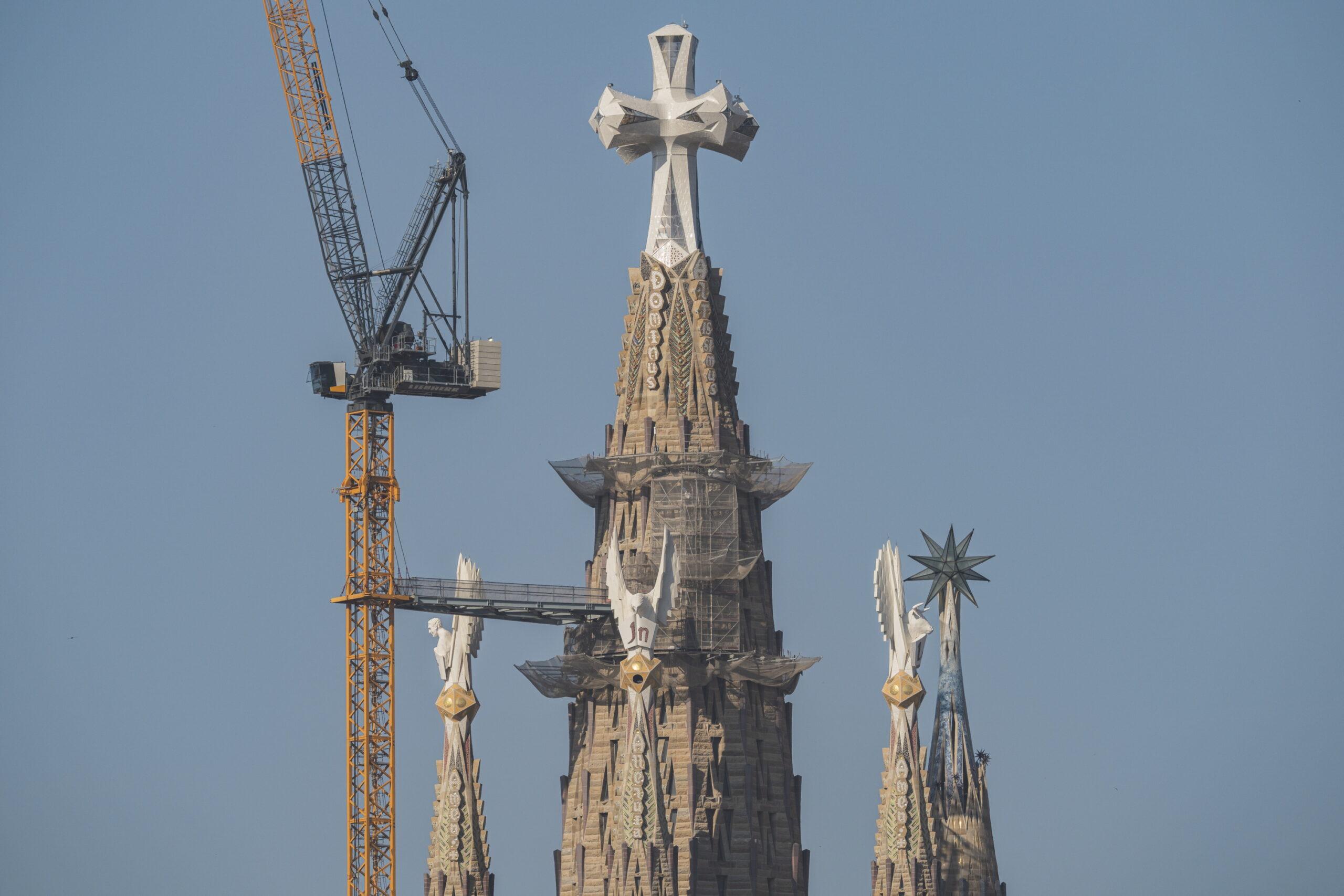
In 2003 I visited Barcelona and spent all day wandering around the mighty Basilica de la Sagrada Família, the architectural masterpiece of Antoni Gaudí. It had been under construction since 1882, and at the time only four of its 18 planned spires had been built. In the basement there was a museum with plans, renderings, and so on, and I discovered the plans for what it would look like when it was finished.
Then I waited 23 years, and now the moment has come. The largest and best of the spires is finished, and it does follow the plans I saw so long ago. Here's what it looks like:
Let's focus in on the detail I waited so long to see:
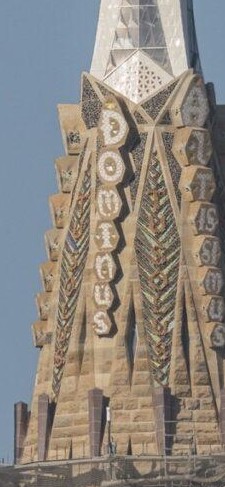
It was worth the wait.
[Other articles in category /art] permanent link
Fri, 12 Jun 2026!!\def\u#1{\frac1{#1}}!!
The ancient Egyptians had a terrible notation for fractions. They had notations for !!\u n!! for each !!n!!, for !!\frac23!!, but everything else was written as a sum of these, with repeats forbidden, so that for example !!\frac25!! had to be written as !!\u3 + \u{15}!!. (Wikipedia)
In an older article about Egyptian fractions and the Rhind Mathematical Papyrus, I said:
Getting the table of good-quality representations of !!\frac2n!! is not trivial, and requires searching, number theory, and some trial and error. It's not at all clear that !!\frac2{105}=\u{90} + \u{126}!!.
I think I see now where this comes from. !!105 = 3·7·5!!, so two of the summands must have denominators divisible by !!5!! and by !!7!! respectively. The first thing you should do is consider $$\u5 + \u7 = \frac{12}{35} = \frac{36}{105}.$$
But you don't want !!\frac{36}{105}!!, you want !!\frac{2}{105}!!, so you multiply by !!\u{18}!!:
$$\u{18}\left(\u5 + \u7\right) = \u{90}+\u{126} = \frac 2{105}$$
and there it is.
Why pick !!\u5!! and !!\u7!! rather than, say, !!\u3!! and !!\u5!!? I suspect the answer is probably: Ahmes (or someone earlier) tried it both ways and picked the result they liked best. Remember Ahmes is compiling a reference table here, so he does these calculations once, writes down the best result, and throws the others away.
If you do the same trick with !!3!! and !!5!! instead you get !!\u3+\u5 = \frac8{15} = \frac{56}{105}!!. Then you multiply everything by !!\u{28}!! producing $$\u{84} + \u{140} = \frac2{105}$$ which seems a little worse than the other one. Using the !!3!! and the !!5!! produces $$\u{75} + \u{175} = \frac2{105}$$ which seems much worse.
Of course this only works when the denominator is composite.
Here's another approach, which doesn't work too well in this case but might be useful for other examples. Consider that !!\frac23 = \u2 + \u6!!. We want !!\frac2{105} = \u{35}\cdot\frac23!!. So
$$ \begin{align} \frac2{105} & = \u{35}\cdot\frac23 \\ & = \u{35}\left(\u2+\u6\right) \\ & = \u{70} + \u{210} \end{align} $$
The denominators here are a lot bigger than the first expansion, but they do at least have the advantage of being multiples of !!10!!. The Egyptians like this because they, like us, often need to multiply numbers by !!10!!, and whereas a fraction like !!\u{126}!! is hard for them to multiply by !!10!!, it's trivial to multiply !!\u{210}!! by !!10!!.
[Other articles in category /math] permanent link