


Sat, 19 Jul 2014
Similarity analysis of quilt blocks
As I've discussed elsewhere, I once wrote a program to enumerate all
the possible quilt blocks of a certain type. The quilt blocks in
question are, in quilt jargon, sixteen-patch half-square triangles. A
half-square triangle, also called a “patch”, is two triangles of fabric sewn together, like
this: 
Then you sew four of these patches into a four-patch, say like this:

Then to make a sixteen-patch block of the type I was considering, you take four identical four-patch blocks, and sew them together with rotational symmetry, like this:
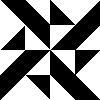
It turns out that there are exactly 72 different ways to do this. (Blocks equivalent under a reflection are considered the same, as are blocks obtained by exchanging the roles of black and white, which are merely stand-ins for arbitrary colors to be chosen later.) Here is the complete set of 72:
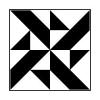
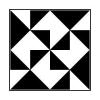
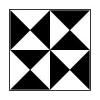
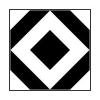
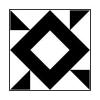
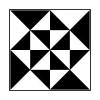
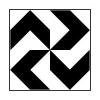
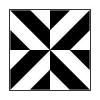
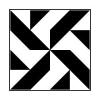
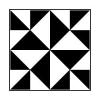
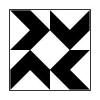
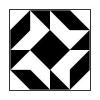
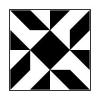
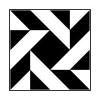
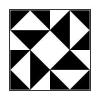
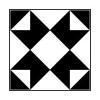
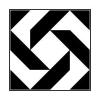
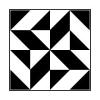
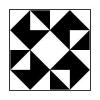
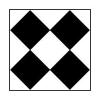
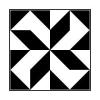
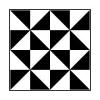
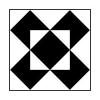
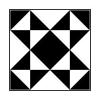
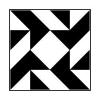
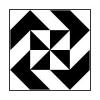
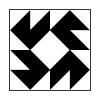
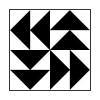
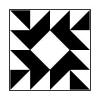
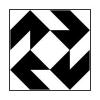
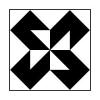
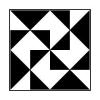
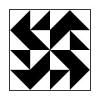
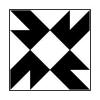
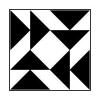
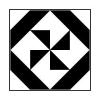
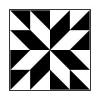
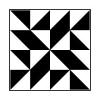
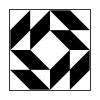
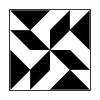
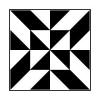
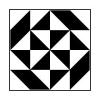
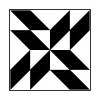
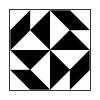
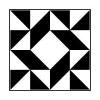
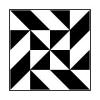
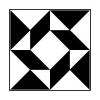
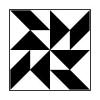
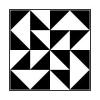
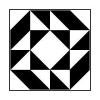
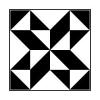
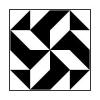
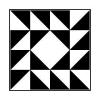
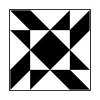
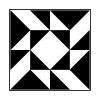
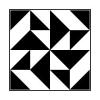
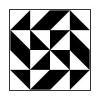
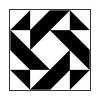
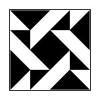
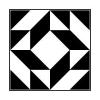
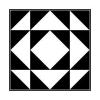
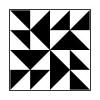
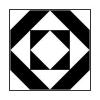
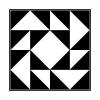
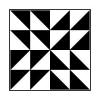
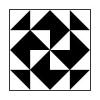
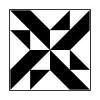
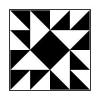
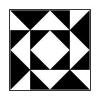
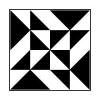
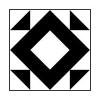
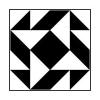
It's immediately clear that some of these resemble one another, sometimes so strongly that it can be hard to tell how they differ, while others are very distinctive and unique-seeming. I wanted to make the computer classify the blocks on the basis of similarity.
My idea was to try to find a way to get the computer to notice which
blocks have distinctive components of one color. For example, many
blocks have a distinctive diamond shape  in the center.
Some have a pinwheel like this:

which also has the diamond in the middle, while others have a different kind of pinwheel with no diamond:

I wanted to enumerate such components and ask the computer to list which blocks contained which shapes; then group them by similarity, the idea being that that blocks with the same distinctive components are similar.
The program suite uses a compact notation of blocks and of shapes that makes it easy to figure out which blocks contain which distinctive components.
Since each block is made of four identical four-patches, it's enough just to examine the four-patches. Each of the half-square triangle patches can be oriented in two ways:


Here are two of the 12 ways to orient the patches in a four-patch:
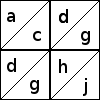
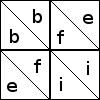
Each 16-patch is made of four four-patches, and you must imagine that the
four-patches shown above are in the upper-left position in the
16-patch. Then symmetry of the 16-patch block means that triangles with the
same label are in positions that are symmetric with respect to the
entire block. For example, the two triangles labeled b are on
opposite sides of the block's northwest-southeast diagonal. But there
is no symmetry of the full 16-patch block that carries triangle d to
triangle g, because d is on the edge of the block, while g is in the interior.
Triangles must be colored opposite colors if they are part of the same patch, but other than that there are no constraints on the coloring.
A block might, of course, have patches in both orientations:
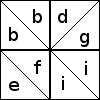
All the blocks with diagonals oriented this way are assigned
descriptors made from the letters bbdefgii.
Once you have chosen one of the 12 ways to orient the diagonals in the
four-patch, you still have to color the patches. A descriptor like
bbeeffii describes the orientation of the diagonal lines in the
squares, but it does not describe the way the four patches are
colored; there are between 4 and 8 ways to color each sort of
four-patch. For example, the bbeeffii four-patch shown earlier can be colored in six different ways:
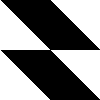
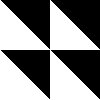




In each case, all four diagonals run from northwest to southeast. (All other ways of coloring this four-patch are equivalent to one of these under one or more of rotation, reflection, and exchange of black and white.)
We can describe a patch by listing the descriptors of the eight triangles, grouped by which triangles form connected regions. For example, the first block above is:
b/bf/ee/fi/i
because there's an isolated white b triangle, then a black parallelogram
made of a b and an f patch, then a white triangle made from the
two white e triangles, then another parallelogram made from the black f
and i, and finally in the middle, the white i. (The two white e
triangles appear to be separated, but when four of these four-patches are
joined into a 16-patch block, the two white e patches will be
adjacent and will form a single large triangle:  )
)
The other five bbeeffii four-patches are, in the same order they are shown above:
    b/b/e/e/f/f/i/i
    b/b/e/e/fi/fi
    b/bfi/ee/f/i
    bfi/bfi/e/e
    bf/bf/e/e/i/i
All six have bbeeffii, but grouped differently depending on the
colorings. The second one (
b/b/e/e/f/f/i/i) has no regions with
more than one triangle; the fifth (
bfi/bfi/e/e) has two large regions of three triangles each, and two
isolated triangles. In the latter four-patch, the bfi in the
descriptor has three letters because the patch has a corresponding
distinctive component made of three triangles.
I made up a list of the descriptors for all 72 blocks; I think I did
this by hand. (The work directory contains a blocks
file that maps
blocks to their descriptors, but the
Makefile does
not say how to build it, suggesting that it was not automatically
built.) From this list one can automatically
extract a
list of descriptors of interesting
shapes: an
interesting shape is two or more letters that appear together in some
descriptor. (Or it can be the single letter j, which is
exceptional; see below.) For example, bffh represents a distinctive
component. It can only occur in a patch that has a b, two fs, and
an h, like this one:
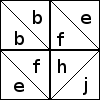
and it will only be significant if the b, the two fs, and the h are
the same color:

in which case you get this distinctive and interesting-looking hook component.
There is only one block that includes this distinctive hook component;
it has descriptor b/bffh/ee/j, and looks like this:  . But some of the distinctive
components are more common. The
. But some of the distinctive
components are more common. The ee component represents the large white half-diamonds on the four sides.
A block with "ee" in its descriptor always looks like this:

and the blocks formed from such patches always have a distinctive half-diamond component on each edge, like this:
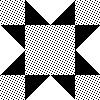
(The stippled areas vary from block to block, but the blocks with ee
in their descriptors always have the half-diamonds as shown.)
The blocks listed at http://hop.perl.plover.com/quilt/analysis/images/ee.html
all have the ee component. There are many differences between them, but
they all have the half-diamonds in common.
Other distinctive components have similar short descriptors. The two pinwheels I
mentioned above are

gh and

fi, respectively; if you look at
the list of gh blocks
and
the list of fi blocks
you'll see all the blocks with each kind of pinwheel.
Descriptor j is an exception. It makes an interesting shape all by itself,
because any block whose patches have j in their descriptor will have
a distinctive-looking diamond component in the center. The four-patch looks like
this:

so the full sixteen-patch looks like this:

where the stippled parts can vary. A look at the list of blocks with
component
j will
confirm that they all have this basic similarity.
I had made a list of the descriptors for each of the 72 blocks, and from this I extracted a list of the descriptors for interesting component shapes. Then it was only a matter of finding the component descriptors in the block descriptors to know which blocks contained which components; if the two blocks share two different distinctive components, they probably look somewhat similar.
Then I sorted the blocks into groups, where two blocks were in the same group if they shared two distinctive components. The resulting grouping lists, for each block, which other blocks have at least two shapes in common with it. Such blocks do indeed tend to look quite similar.
This strategy was actually the second thing I tried; the first thing didn't work out well. (I forget just what it was, but I think it involved finding polygons in each block that had white inside and black outside, or vice versa.) I was satisfied enough with this second attempt that I considered the project a success and stopped work on it.
The complete final results were:
- This tabulation of blocks that are somewhat similar
- This tabulation of blocks that are distinctly similar (This is the final product; I consider this a sufficiently definitive listing of “similar blocks”.)
- This tabulation of blocks that are extremely similar
And these tabulations of all the blocks with various distinctive components: bd bf bfh bfi cd cdd cdf cf cfi ee eg egh egi fgh fh fi gg ggh ggi gh gi j
It may also be interesting to browse the work directory.
[Other articles in category /misc] permanent link