


Tue, 05 Nov 2019
A while back a YouTube video was going around titled Octopus Intelligence Experiment Takes an Unexpected Turn. Someone put food in a baby bottle with a screw cap and a rubber nipple. There was a hole drilled in the bottle so that the octopus could reach in to taste the food, but it was not large enough for the food to come out or for the octopus to go in. The idea, I suppose, was that the octopus would figure out how to unscrew the cap.
The “unpexected turn” was that instead of unscrewing the cap, the octopus just ripped the entire nipple out of the bottle.
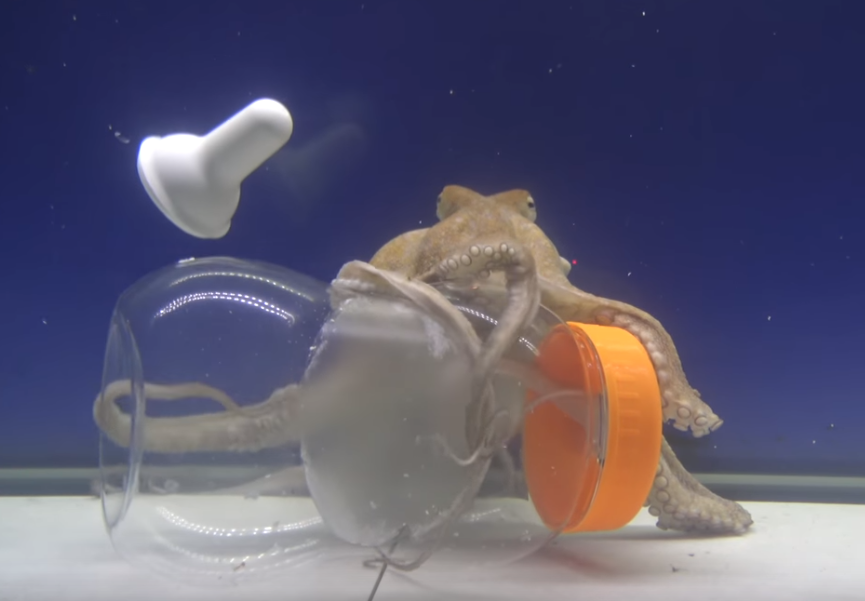
I have mentioned this before but it bears repeating: this outcome should not have been an unexpected turn:
Crabs can be wrested from containers (Pieron, 1911; Schiller, 1948; Cousteau and Diole, 1973) but the results appear to be achieved by chance and there is little indication that the octopus can learn to deal with the situation more efficiently with practice. The animal approaches and struggles with the apparatus until something happens; if it learns anything as a result of its experience it is only to be more persistent and vigorous.
(Martin Wells, Octopus: Physiology and Behaviour of an Advanced Invertebrate (Springer, 1978), page 241.)
[Other articles in category /bio/octopus] permanent link
Thu, 26 Jan 2006
The octopus and the creation of the cosmos
In
an earlier post, I mentioned the lucky finds you sometimes make
when you're wandering at random in a library. Here's another such.
In 2001 I was in Boston with my wife, who was attending the United
States Figure Skating Championships. Instead of attending the Junior
Dance Compulsories, I went to the Boston Public Library, where I
serendipitously unearthed the following treasure:
Although we have the source of all things from chaos, it is a chaos which is simply the wreck and ruin of an earlier world....The drama of creation, according to The Hawaiian account, is divided into a series of stages, and in the very first of these life springs from the shadowy abyss and dark night...At first the lowly zoophytes and corals come into being, and these are followed by worms and shellfish, each type being declared to conquer and destroy its predecessor, a struggle for existence in which the strongest survive....As type follows type, the accumulating slime of their decay raises land above the waters, in which, as spectator of all, swims the octopus, the lone survivor of an earlier world.(Mythology of All Races, vol. ix ("Oceanic"), R.B. Dixon. Thanks to the wonders of the Internet, you can now read the complete text online.)
Everyone, it seems, recognizes the octopus as a weird alien, unique in our universe.
[Other articles in category /bio/octopus] permanent link