Mark Dominus (陶敏修)
mjd@pobox.com

Archive:
| 2026: | JFM |
| 2025: | JFMAMJ |
| JASOND | |
| 2024: | JFMAMJ |
| JASOND | |
| 2023: | JFMAMJ |
| JASOND | |
| 2022: | JFMAMJ |
| JASOND | |
| 2021: | JFMAMJ |
| JASOND | |
| 2020: | JFMAMJ |
| JASOND | |
| 2019: | JFMAMJ |
| JASOND | |
| 2018: | JFMAMJ |
| JASOND | |
| 2017: | JFMAMJ |
| JASOND | |
| 2016: | JFMAMJ |
| JASOND | |
| 2015: | JFMAMJ |
| JASOND | |
| 2014: | JFMAMJ |
| JASOND | |
| 2013: | JFMAMJ |
| JASOND | |
| 2012: | JFMAMJ |
| JASOND | |
| 2011: | JFMAMJ |
| JASOND | |
| 2010: | JFMAMJ |
| JASOND | |
| 2009: | JFMAMJ |
| JASOND | |
| 2008: | JFMAMJ |
| JASOND | |
| 2007: | JFMAMJ |
| JASOND | |
| 2006: | JFMAMJ |
| JASOND | |
| 2005: | OND |
In this section:
| Almost-trivial theorems |
| An anecdote about backward compatibility |
| Crooked politicians love crab cakes! |
Subtopics:
| Mathematics | 246 |
| Programming | 100 |
| Language | 95 |
| Miscellaneous | 75 |
| Book | 50 |
| Tech | 49 |
| Etymology | 36 |
| Haskell | 33 |
| Oops | 30 |
| Unix | 27 |
| Cosmic Call | 25 |
| Math SE | 25 |
| Law | 23 |
| Physics | 21 |
| Perl | 17 |
| Biology | 16 |
| Brain | 15 |
| Calendar | 15 |
| Food | 15 |


Comments disabled
Wed, 28 Jan 2026
Crooked politicians love crab cakes!
I recently posted an article about the 2013 Philadelphia Traffic Court fiasco, in which most of the Traffic Court judges were convicted of accepting bribes:
According to the indictment, Perri accepted free auto services, towing, landscaping, and even a load of shrimp and crab cakes from Alfano, whose company, Century Motors, ran a towing service.
(The Philadelphia Inquirer, Nine current and former Traffic Court judges charged; Martin, John P. and Craig R. McCoy; January 31, 2013)
Then in 2024, John “Johnny Doc” Dougherty, an influential Philadelphia union boss, pled guilty to embezzlement and bribery, paid in part in, guess what?
“Tomorrow, tell your mom and dad not to cook, I got crab cakes coming from the Palm,” Dougherty is heard telling her in a 2015 phone call recorded during the 16-month period that the FBI tapped his cell phone.
(The Philadelphia Inquirer, For leader John Dougherty, union-paid generosity began at home; Fazollah, Mark, Dylan Purcell, Jeremy Roebuck, and Craig R. McCoy; Feb 5 2019)
He called them out specifically in his guilty plea:
“I let the lines get blurred,” he said. “I got over my head. … My intention wasn’t to figure out how I could get a crab cake and not pay for it.”
(The Philadelphia Inquirer, ‘I am guilty:’ John Dougherty’s stunning statements at sentencing delivered an about-face few had predicted; Roebuck, Jeremy and Oona Goodin-Smith; July 13, 2024.)
And now, in today's New York Times, I find:
Across five indictments, prosecutors said [former New York mayor's aide Ingrid Lewis-Martin] used her proximity to the mayor to help fast-track approvals from city agencies, steered contracts to a favored developer and tried to kill a project to build protected bike lanes in Brooklyn.
In turn, she received cash, crab cakes, home renovations and even an appearance on a popular television show, they said.
(The New York Times, Former Adams Aide Took Diamond Earrings as Bribe, Prosecutors Say; Meko, Hurubie; January 27, 2026.)
Poor Fenchurch, usually a gentle soul, is speechless with indignation.
[Other articles in category /law] permanent link
A couple of years back I wrote an article about this bit of mathematical folklore:
Mathematical folklore contains a story about how Acta Quandalia published a paper proving that all partially uniform k-quandles had the Cosell property, and then a few months later published another paper proving that no partially uniform k-quandles had the Cosell property. And in fact, goes the story, both theorems were quite true, which put a sudden end to the investigation of partially uniform k-quandles.
I have an non-apocryphal update in this space! In episode 94 of the podcast “My Favorite Theorem”, Jeremy Alm of Lamar University reports:
My main dissertation result was a conditional result. And about four years after I graduated, a Hungarian graduate student proved that my condition, like my additional hypothesis, held in only trivial cases.
(At 04:15)
In the earlier article, I had said:
Suppose you had been granted a doctorate on the strength of your thesis on the properties of objects from some class which was subsequently shown to be empty. Wouldn't you feel at least a bit like a fraud?
In the podcast, Alm introduces this as evidence that he “wasn't very good at algebra”. Fortunately, he added, it was after he had graduated.
The episode title is “In Which Every Thing Happens or it Doesn't”. I started listening to it because I expected it to be about the ergodic theorem, and I'd like to understand the ergodic theorem. But it turned out to be about the Rado graph. This is fine with me, since I love the Rado graph. (Who doesn't?)
[Other articles in category /math] permanent link
Mon, 26 Jan 2026
An anecdote about backward compatibility
A long time ago I worked on a debugger program that our company used to debug software that it sold that ran on IBM System 370. We had IBM 3270 CRT terminals that could display (I think) eight colors (if you count black), but the debugger display was only in black and white. I thought I might be able to make it a little more usable by highlighting important items in color.
I knew that the debugger used a macro called WRTERM to write text to
the terminal, and I thought maybe the description of this macro in the
manual might provide some hint about how to write colored text.
In those days, that office didn't have online manuals, instead we had shelf after shelf of yellow looseleaf binders. Finding the binder you wanted was an adventure. More than once I went to my boss to say I couldn't proceed without the REXX language reference or whatever. Sometimes he would just shrug. Other times he might say something like “Maybe Matthew knows where that is.”
I would go ask Matthew about it. Probably he would just shrug. But if he didn't, he would look at me suspiciously, pull the manual from under a pile of papers on his desk, and wave it at me threateningly. “You're going to bring this back to me, right?”
See, because if Matthew didn't hide it in his desk, he might become the person who couldn't find it when he needed it.
Matthew could have photocopied it and stuck his copy in a new binder, but why do that when burying it on his desk was so much easier?
For years afterward I carried around my own photocopy of the REXX language reference, not because I still needed it, but because it had cost me so much trouble and toil to get it. To this day I remember its horrible IBM name: SC24-5239 Virtual Machine / System Product System Product Interpreter Reference. That's right, "System Product" was in there twice. It was the System Product Interpreter for the System Product, you see.
Anyway, I'm digressing. I did eventually find a copy of the IBM
Assembler Product Macro Reference Document or whatever it was called,
and looked up WRTERM and to my delight it took an optional parameter
named COLOR. Jackpot!
My glee turned to puzzlement. If omitted, the default value for
COLOR was BLACK.
Black? Not white? I read further.
And I learned that the only other permitted value was RED, and only
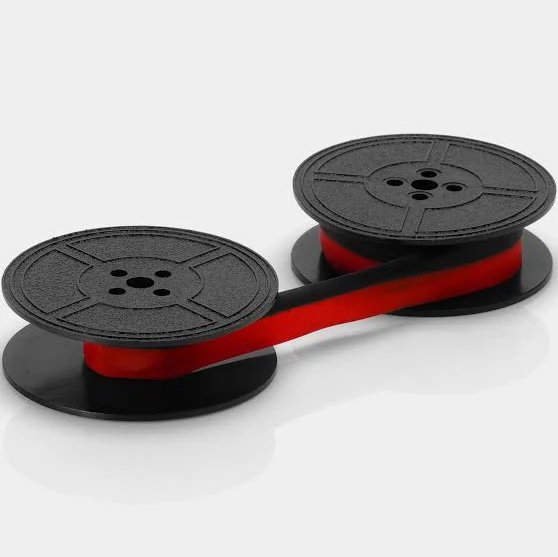
if your terminal had a “two-color ribbon”.
[Other articles in category /prog] permanent link